

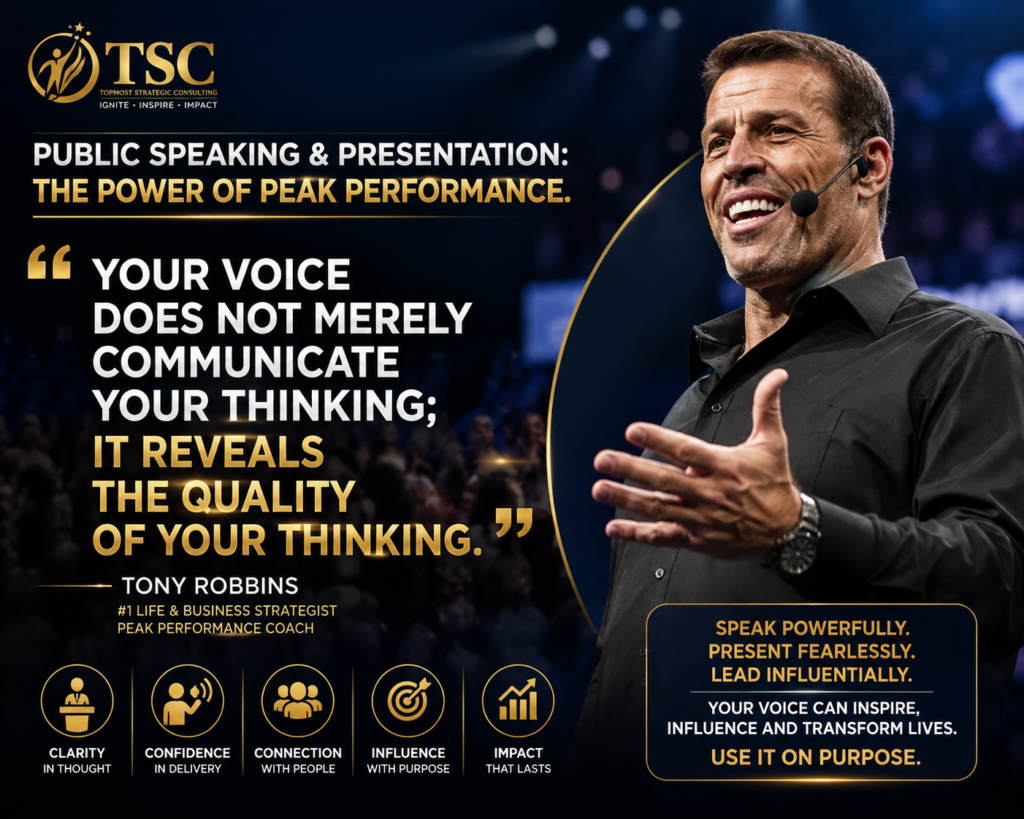
Public Speaking & Presentation: The Self-Leadership Vehicle
“Your voice does not merely communicate your thinking; it reveals the quality of your thinking.”
Public speaking is often treated as the ability to stand before people and speak confidently. That is only the surface.
At a deeper level, public speaking and presentation are strategic self-leadership competencies. They enable you to organize your thoughts, manage your emotions, understand people, communicate value, influence decisions and move others toward purposeful action.
You may never stand on a large stage—but every day you are presenting: an idea to your boss, a proposal to a client, feedback to a colleague, a vision to your team, or your values to your family.
Every meaningful conversation is an opportunity to lead.
1. What Is Public Speaking & Presentation?
Public speaking is the ability to think clearly, communicate deliberately and influence responsibly in front of others.
Presentation is broader than speaking. It combines:
Thinking + Message + Structure + Voice + Body + Emotion + Audience + Influence + Action
A great presenter does not simply ask:
“What do I want to say?”
A strategic presenter asks:
“What does my audience need to understand, feel, believe and do?”
That shift transforms speaking from information delivery into leadership.
2. Why Is It a Self-Leadership Skill?
Before you can influence others, you must manage yourself.
| Self-Leadership Challenge | Public Speaking Develops |
|---|---|
| Fear | Emotional control |
| Confusion | Structured thinking |
| Overthinking | Decision clarity |
| Low confidence | Self-belief through preparation |
| Impulsive communication | Response discipline |
| Lack of awareness | Audience sensitivity |
| Weak expression | Communication precision |
| Difficulty influencing | Persuasive thinking |
| Poor listening | Situational awareness |
Your presentation becomes a mirror of your internal leadership.
If your thinking is scattered, your message becomes scattered.
If your emotions control you, your delivery becomes unstable.
If your purpose is unclear, your audience becomes confused.
Therefore:
Master yourself → Master your message → Influence others.
3. The 360° Public Speaking Model
Use the MIND–MESSAGE–MEDIUM–MOMENT–MOVE model.
M — Mind
Prepare your internal state before preparing your slides.
Ask:
- What is my purpose?
- What am I feeling?
- What could make me nervous?
- What outcome do I want?
- What must I believe about myself?
Rule: Confidence is not the absence of nervousness.
Confidence is the ability to perform despite nervousness.
I — Intent
Every presentation needs one dominant objective.
Are you trying to:
- Inform?
- Inspire?
- Persuade?
- Teach?
- Solve?
- Sell?
- Align?
- Mobilize?
One presentation can contain several elements, but it should have one primary intention.
N — Narrative
People remember meaning better than information.
Build your message around:
Problem → Insight → Solution → Evidence → Action
Instead of giving twenty disconnected points, create one journey.
D — Delivery
Your audience experiences your message through:
- Voice
- Pace
- Pauses
- Eye contact
- Facial expression
- Gestures
- Posture
- Energy
- Silence
Your body speaks before your words are processed.
4. The Strategic Presenter’s 5 Questions
Before every important presentation, answer:
- WHO am I speaking to?
- WHY does this matter to them?
- WHAT must they remember?
- HOW do I make it relevant?
- WHAT NEXT should they do?
This prevents the most common presentation mistake:
Speaking from the speaker’s perspective instead of the audience’s perspective.
5. Situation Analysis: Choose the Right Speaking Strategy
Different situations require different approaches.
| Situation | Strategic Approach |
|---|---|
| Meeting | Clarity + brevity |
| Training | Explain + demonstrate + practice |
| Sales presentation | Problem + value + proof + action |
| Leadership speech | Vision + meaning + direction |
| Conflict | Listen + acknowledge + reframe |
| Interview | Evidence + confidence + relevance |
| Crisis communication | Facts + empathy + action |
| Team briefing | Alignment + accountability |
| Public event | Story + emotion + memorable message |
| Board/CXO presentation | Insight + evidence + decision |
Great speakers don’t use one speaking style everywhere. They adapt.
6. Strategic Frameworks for Mastery
A. PREP — For Clear Answers
P — Point
State your position.
R — Reason
Explain why.
E — Example
Give evidence or illustration.
P — Point
Close with the key message.
Useful for meetings, interviews, Q&A and leadership discussions.
B. OODA — For Difficult Questions
When challenged:
Observe → Orient → Decide → Act
Do not react immediately.
Pause.
Understand the question.
Identify what is really being asked.
Then respond.
Strategic silence is not weakness.
Sometimes the most powerful communication begins with a two-second pause.
C. SWOT — For Presentation Preparation
Before a major presentation, examine:
- Strengths: What do I know exceptionally well?
- Weaknesses: Where could I lose credibility?
- Opportunities: What can this audience relationship create?
- Threats: What objections, distractions or resistance may arise?
This converts preparation from rehearsal into strategic readiness.
D. 80/20 — For Message Design
Do not overload your audience with 100 facts.
Identify the 20% of ideas that create 80% of the understanding or impact.
Ask:
“If my audience remembers only three things tomorrow, what should they be?”
Those three ideas become your communication anchors.
7. The Influence Equation
A useful practical model is:
Influence = Credibility × Clarity × Connection × Consistency
If any one factor approaches zero, influence suffers.
Credibility — Do people trust your knowledge and character?
Clarity — Can they understand your message?
Connection — Do they feel that you understand them?
Consistency — Does your communication match your behaviour?
This is why influence cannot be manufactured through presentation tricks.
People may listen to your words, but they respond to your perceived authenticity.
8. The Power of Storytelling
Facts inform.
Stories create meaning.
A powerful professional story can follow:
Situation → Struggle → Turning Point → Insight → Transformation → Lesson
For example, instead of saying:
“Adaptability is important.”
Tell the story of a team that resisted change, experienced consequences, learned something, adapted and achieved a better outcome.
Then extract the principle.
Story → Emotion → Meaning → Memory → Action
That is why storytelling is one of the strongest weapons in a Psychotech Leader’s communication toolkit.
9. Handling Fear, Anxiety & Pressure
Do not fight nervousness.
Channel it.
Before speaking:
- Take slower breaths.
- Ground your feet.
- Relax your shoulders.
- Rehearse your opening.
- Visualize the desired outcome.
- Focus on serving the audience rather than judging yourself.
- Start slower than your natural conversational speed.
Replace:
“What if I fail?”
with:
“What value can I create for these people?”
Self-focus increases pressure.
Purpose-focus increases performance.
10. The 7-Step Presentation Architecture
For an important presentation, use:
1. Hook
Capture attention.
2. Context
Explain why the topic matters.
3. Problem
Identify the challenge.
4. Insight
Reveal something valuable.
5. Solution
Present your approach.
6. Evidence
Use examples, data, stories or demonstrations.
7. Action
Tell people what to do next.
Never end merely with “Thank you.” End with direction.
11. Your 30-Day Mastery Practice
Week 1 — Think
- Speak for two minutes daily on one topic.
- Record yourself.
- Identify unclear thinking.
Week 2 — Structure
- Practice PREP.
- Convert complex ideas into three points.
- Practice opening and closing statements.
Week 3 — Deliver
- Practice pauses.
- Improve eye contact.
- Vary pace and emphasis.
- Remove unnecessary words.
Week 4 — Influence
- Tell one story daily.
- Practice handling objections.
- Present one idea designed to produce action.
Measure yourself from 1–10 on:
Clarity | Confidence | Structure | Voice | Body Language | Storytelling | Audience Connection | Influence | Q&A | Action Orientation
Don’t aim for perfection.
Aim for 1% improvement per presentation.
12. The Psychotech Leader’s Communication Weapon
A Psychotech Leader understands that influence is the spark that can ignite purposeful action.
But influence without responsibility becomes manipulation.
Therefore, use public speaking to:
- Clarify confusion.
- Create confidence.
- Challenge limiting thinking.
- Build collaboration.
- Inspire ownership.
- Create alignment.
- Turn ideas into decisions.
- Turn decisions into action.
The ultimate test of a presentation is not:
“Did they applaud?”
It is:
“Did their thinking change?”
And beyond that:
“Did their behaviour improve?”
Final Self-Leadership Principle
Public speaking is not fundamentally about speaking in public.
It is about leading yourself publicly.
When you can control your state, organize your thinking, simplify complexity, understand your audience, communicate with authenticity and inspire purposeful action, your voice becomes more than a communication tool.
It becomes a leadership instrument.
Remember the Psychotech Speaker Formula:
Clear Mind → Clear Message → Strong Presence → Human Connection → Ethical Influence → Purposeful Action
Master your mind.
Master your message.
Master your presence.
Then use your voice to help others master theirs.
“A powerful speaker does not merely occupy a stage; a powerful leader occupies the minds, hearts and possibilities of people.”

ANUPAM SHARMA
PSYCHOTECH™ PRO STRATEGIST
COACH I MENTOR I TRAINER
COUNSELLOR I CONSULTANT