
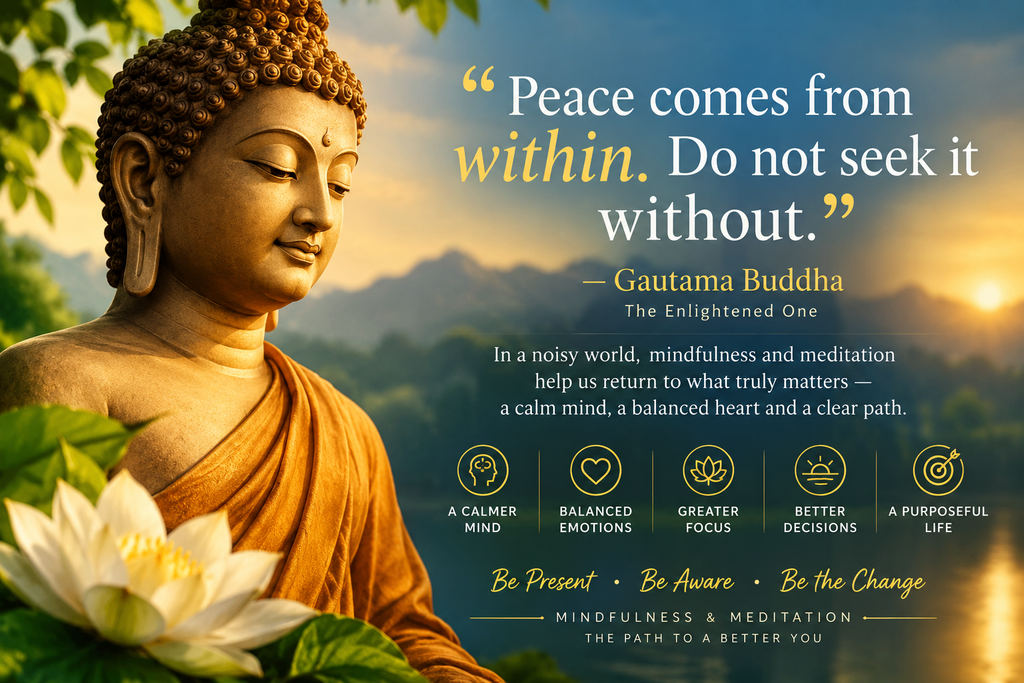
The key is to treat mindfulness and meditation not as relaxation activities, but as trainable self-leadership capabilities—the ability to pause, observe, regulate, think clearly, choose wisely and act purposefully.
Mindfulness & Meditation @ 360°
The Psychotech Self-Leadership Vehicle for a Clearer Mind, Calmer Emotions & Strategic Action
“Between stimulus and response there is a space. In that space lies our power to choose our response.”
Modern life creates an extraordinary problem: we have more information, but less attention; more connectivity, but less presence; more choices, but often less clarity.
Emails, WhatsApp, social media, meetings, deadlines, financial pressures, family responsibilities and constant uncertainty keep the mind in a state of continuous stimulation.
The strategic advantage today is therefore not simply knowing more.
It is being able to control where, when and how you direct your attention.
That is where Mindfulness + Meditation becomes a powerful Psychotech leadership capability.
1. First Understand the Difference
| Mindfulness | Meditation |
|---|---|
| Quality of awareness | Practice for training awareness |
| Being fully present | Deliberately training attention |
| Observing thoughts/emotions | Sitting, walking, breathing or focusing systematically |
| Can be practised anywhere | Usually requires dedicated practice |
| “What is happening now?” | “Let me train my mind to observe it.” |
| Improves moment-to-moment choices | Builds the capacity for sustained awareness |
Simple formula
Meditation → trains attention → Mindfulness → improves awareness → Awareness → improves choices → Choices → improve behaviour → Behaviour → produces outcomes.
That makes it a self-leadership system, not merely a wellness activity.
2. Why Mindfulness Matters in the AI & Noise Era
The greatest competition of the future may be:
Human Attention vs Machine Distraction.
AI can increasingly provide information, analysis and recommendations.
But humans still need to decide:
- What deserves my attention?
- What should I ignore?
- What really matters?
- What am I feeling?
- Why am I reacting?
- What is the evidence?
- What should I do next?
Therefore:
Attention → Awareness → Discernment → Decision → Action
This is the foundation of Psychotech Strategic Leadership.
3. The 5W1H of Mindfulness & Meditation
| Question | Strategic Answer |
|---|---|
| Why? | To develop attention, emotional regulation, clarity and intentional action |
| What? | Training yourself to notice thoughts, emotions, sensations and surroundings without immediately reacting |
| When? | Daily—and especially before important decisions, conversations and difficult situations |
| Where? | Anywhere: home, office, car before entering a meeting, walking, exercising |
| Who? | Everyone—but particularly leaders, managers, entrepreneurs, professionals and caregivers |
| How? | Breath awareness, observation, body awareness, mindful walking, reflection and deliberate pauses |
4. The Psychotech MINDFUL Decision Framework™
Before reacting:
P — PAUSE
Stop automatic reaction.
O — OBSERVE
What am I thinking and feeling?
W — WITNESS
Can I observe my thought without becoming the thought?
E — EVALUATE
What are the facts versus my assumptions?
R — RESPOND
What response serves the situation best?
R — REVIEW
What did I learn?
PAUSE → OBSERVE → WITNESS → EVALUATE → RESPOND → REVIEW
This transforms mindfulness into a decision-making tool.
5. The 3-Level Mindfulness Model
Level 1 — Self-Awareness
Ask:
- What am I thinking?
- What am I feeling?
- What is happening in my body?
- What triggered me?
Level 2 — Self-Regulation
Instead of:
Trigger → Reaction
develop:
Trigger → Pause → Awareness → Choice → Response
Level 3 — Strategic Awareness
Now ask:
“What is the bigger picture?”
This is where mindfulness evolves into strategic thinking.
6. Stress Management: The STOP Technique
When pressure rises:
S — Stop
Don’t immediately react.
T — Take 3–5 slow breaths
Bring attention back to the present.
O — Observe
Notice:
- thought
- emotion
- physical tension
- situation
- impulse
P — Proceed
Choose the most constructive next action.
Use it before:
- difficult emails
- negotiations
- arguments
- presentations
- interviews
- important decisions
- conflict conversations
7. The 3-Minute Emergency Reset
When overwhelmed:
Minute 1 — Breathe
Simply notice the natural breath.
Minute 2 — Body
Scan:
- forehead
- jaw
- shoulders
- chest
- stomach
- hands
Relax unnecessary tension.
Minute 3 — Question
Ask:
“What is the one useful thing I can do next?”
Not ten things.
One.
This converts mental overload into purposeful action.
8. The 80/20 Rule of Mindfulness
You do not need hours of meditation to begin.
Focus on the vital few:
20% practices producing 80% benefit
- 5–10 minutes daily meditation
- Mindful breathing before major decisions
- Single-tasking
- Technology-free periods
- Daily reflection
- Mindful listening
- Sleep and recovery discipline
The objective isn’t:
“How long did I meditate?”
The better question is:
“How consciously did I live today?”
9. Mindfulness in Professional Life
Before a meeting
Ask:
What outcome do I want?
During the meeting
Practise:
Listen → Understand → Clarify → Respond
rather than:
Listen → Prepare counterargument.
During conflict
Replace:
“How can I win?”
with:
“What is actually happening here?”
Before sending an angry email
Use:
Pause → Re-read → Reframe → Send.
That single habit can prevent enormous professional damage.
10. Mindfulness for Strategic Thinking
Strategic thinkers need mental space.
Use the FACT framework:
F — Facts
What do I actually know?
A — Assumptions
What am I assuming?
C — Consequences
What could happen if I act?
T — Thoughtful choice
What response creates the greatest constructive outcome?
This prevents emotional impulses from masquerading as strategic decisions.
11. Mindfulness for Anxiety & Overthinking
When the mind repeatedly asks:
“What if something goes wrong?”
Don’t fight the thought.
Instead say:
“I notice that my mind is producing a worry.”
Then separate:
FACT
What is happening now?
FEAR
What am I imagining?
ACTION
What can I control?
ACCEPTANCE
What cannot I control?
This creates psychological distance from the thought.
You are the observer of the thought—not necessarily the thought itself.
For persistent or severe anxiety that interferes with daily functioning, mindfulness should complement—not replace—professional mental-health care.
12. The Daily Psychotech Mindfulness Operating System™
MORNING — 10 minutes
2 min: breathing
3 min: observe thoughts
3 min: visualize priorities
2 min: intention
Ask:
“What kind of person do I want to be today?”
DURING THE DAY
Use Micro-Pauses:
Before answering → Pause
Before deciding → Breathe
Before judging → Understand
Before reacting → Observe
Before speaking → Choose
EVENING — 5 minutes
Ask:
- Where was I fully present?
- Where did I react automatically?
- What triggered me?
- What did I learn?
- What will I do differently tomorrow?
13. The Mindfulness Mastery Scorecard
Rate yourself 1–10 daily:
| Capability | Score |
|---|---|
| Attention | /10 |
| Emotional regulation | /10 |
| Listening | /10 |
| Patience | /10 |
| Decision clarity | /10 |
| Impulse control | /10 |
| Self-awareness | /10 |
| Stress management | /10 |
| Presence | /10 |
| Purposeful action | /10 |
Track for 30 days.
Your goal isn’t perfection.
Your goal is progressive awareness.
14. The Psychotech Leadership Equation™
Mindfulness × Meditation × Self-Awareness × Discipline = Self-Leadership
And:
Self-Leadership × Strategic Thinking = Strategic Leadership
The ultimate objective is therefore not simply:
“Become calm.”
It is:
Become sufficiently aware to choose the right response under pressure.
That is leadership.
15. The 7-Day Starter Challenge
Day 1: 5-minute breath awareness
Day 2: Mindful eating
Day 3: 10-minute technology-free walk
Day 4: Practise mindful listening
Day 5: STOP technique during stress
Day 6: One important decision using FACT
Day 7: 15-minute reflection and weekly review
Repeat for four weeks.
The Ultimate Psychotech Principle
Mindfulness is not escaping life.
Meditation is not running away from problems.
They are training grounds for meeting life more consciously.
A Psychotech Leader learns to create a gap between:
Stimulus → Response
and progressively develops:
Awareness → Choice → Strategic Response → Action → Learning
In a world increasingly dominated by noise, speed, distraction and uncertainty, the person who can command attention, regulate emotion, think clearly and act deliberately possesses an extraordinary competitive advantage.
Your mind is your primary leadership instrument.
Train it.
Observe it.
Regulate it.
Direct it.
Use it purposefully.
That is the essence of Mindfulness + Meditation as a Psychotech Self-Leadership Weapon.

ANUPAMM SHARMA
PSYCHOTECH™ PRO STRATEGIST
COACH I MENTOR I TRAINER
COUNSELLOR I CONSULTANT