

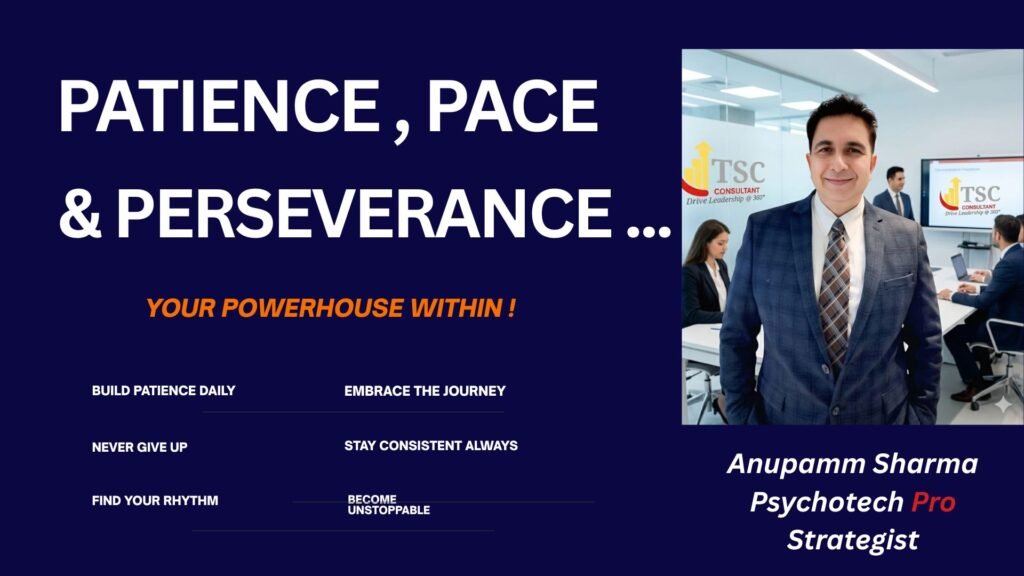
The key distinction is that patience is not waiting—it is disciplined self-management while pursuing a purposeful outcome. For a Psychotech Pro Leader, personality determines how one behaves under pressure, patience determines how well one manages the gap between effort and outcome, perseverance sustains the effort, and pace prevents either impatience or unnecessary delay.
PERSONALITY WITH PATIENCE
The Crux of Psychotech Pro Leadership
“Patience is not the absence of urgency; it is the ability to remain purposeful while urgency is present.”
In personal and professional life, everybody practises patience, perseverance and pace—knowingly or unknowingly.
We wait for results.
We deal with difficult people.
We learn new skills.
We face uncertainty.
We manage setbacks.
We build relationships.
We make decisions without having complete information.
The difference between an ordinary performer and a Psychotech Pro Leader is not whether pressure exists.
It is how the person manages himself while pressure exists.
That is why:
PERSONALITY + PATIENCE + PERSEVERANCE + PURPOSEFUL PACE = SELF-LEADERSHIP
1. WHY “PERSONALITY WITH PATIENCE” IS THE CRUX
Personality is expressed most clearly when circumstances do not go according to plan.
Anyone can appear calm when everything is easy.
The real test comes when:
- someone disagrees with you
- results are delayed
- people make mistakes
- expectations are not met
- decisions are difficult
- success takes longer than expected
- criticism feels unfair
- uncertainty creates anxiety
- you are under time pressure
Here patience becomes a personality strength.
A patient personality does not mean being weak, slow, passive or tolerant of everything.
It means:
I can control my response without losing my purpose.
That is powerful self-leadership.
2. THE 360° ANATOMY OF PATIENCE
| Dimension | Patient Leadership Looks Like |
|---|---|
| Thinking | Think before concluding |
| Emotions | Feel without immediately reacting |
| Communication | Listen before responding |
| Decision-making | Avoid impulsive decisions |
| Relationships | Give people reasonable space to improve |
| Execution | Continue despite delayed rewards |
| Learning | Accept that mastery takes time |
| Leadership | Develop people instead of expecting instant perfection |
| Change | Adapt without unnecessary resistance |
| Personal growth | Trust disciplined effort over instant gratification |
Thus, patience is not one behaviour.
It is a pattern of intelligent self-management.
3. PATIENCE ≠ PASSIVITY
This is one of the most important distinctions for a Psychotech Leader.
Passive waiting says:
“Let us see what happens.”
Patient action says:
“I will do what I can control, monitor what I cannot, and respond intelligently to what happens.”
Therefore:
Patience = Calmness + Clarity + Continued Action
A leader who waits without action is passive.
A leader who acts without patience can become impulsive.
A Psychotech Leader learns to act with urgency but think with patience.
4. THE PATIENCE–PERSEVERANCE–PACE TRIAD
These three qualities work together.
PATIENCE — How you manage the waiting
Keeps emotions and judgement balanced.
PERSEVERANCE — How you continue the effort
Keeps you moving when results are delayed.
PACE — How you manage speed
Prevents both rushing and unnecessary delay.
Think of it as:
Patience gives stability.
Perseverance gives stamina.
Pace gives direction and timing.
Without patience, perseverance can become frustration.
Without perseverance, patience can become passive waiting.
Without pace, both can become inefficient.
5. THE PSYCHOTECH “P3” FRAMEWORK
Use P3 for self-leadership:
P1 — PATIENCE
Pause before reacting.
Ask:
- What is happening?
- What am I feeling?
- What do I actually know?
- What requires immediate action?
- What can wait?
P2 — PERSEVERANCE
Continue purposeful effort.
Ask:
- Is the goal still worthwhile?
- What obstacle is blocking progress?
- What can I change?
- What is the next small step?
P3 — PACE
Choose the appropriate speed.
Ask:
- Is this too fast?
- Is this too slow?
- What does the situation require?
This creates:
Pause → Assess → Persist → Adjust Pace → Execute
6. THE 5W1H OF PERSONALITY WITH PATIENCE
WHAT?
The ability to regulate your response, maintain purpose and continue constructive action despite delay, difficulty or uncertainty.
WHY?
Because uncontrolled impatience damages:
- judgement
- communication
- relationships
- learning
- credibility
- decision quality
- long-term performance
WHEN?
Especially during:
- conflict
- uncertainty
- failure
- waiting
- change
- criticism
- negotiation
- difficult conversations
- delayed results
WHERE?
Everywhere:
Home + Workplace + Leadership + Business + Relationships + Self-development
WHO?
Everyone needs it—but leaders need it at a higher level because their emotional behaviour influences others.
HOW?
Through awareness, deliberate pause, emotional control, purposeful action, repetition and reflection.
7. THE “PAUSE–THINK–CHOOSE–ACT” MODEL
When emotionally triggered:
1. PAUSE
Don’t immediately react.
2. THINK
Separate:
FACT → INTERPRETATION → EMOTION → OPTIONS
3. CHOOSE
Select the response that best serves the desired outcome.
4. ACT
Communicate or act deliberately.
This simple sequence can transform:
Reaction → Response
And:
Impulse → Intelligence
8. SITUATION ANALYSIS: OLD PERSONALITY VS PSYCHOTECH PERSONALITY
| Situation | Automatic Response | Psychotech Response |
|---|---|---|
| Employee makes mistake | “How many times?” | “What happened? What needs correction?” |
| Someone interrupts | Anger | Pause and regain conversational control |
| Result is delayed | Frustration | Review process and continue |
| Criticism | Defensiveness | Listen → assess → extract value |
| Difficult customer | Irritation | Understand need → solve problem |
| Career progress is slow | Give up | Reassess strategy → continue |
| Failure | Self-blame | Learn → adapt → retry |
| Conflict | Win the argument | Protect the relationship and outcome |
| Uncertainty | Overthink | Identify controllables → act |
The goal is not to suppress emotion.
The goal is to prevent emotion from automatically deciding your behaviour.
9. THE 80/20 PATIENCE RULE
Do not try to become patient everywhere at once.
Identify the 20% of situations that create 80% of your impatience.
For example:
- waiting for people
- traffic/delays
- criticism
- slow employees
- technology problems
- financial uncertainty
- delayed results
Then identify your most common trigger.
Ask:
“What behaviour do I repeatedly display when this trigger appears?”
Now replace one unproductive behaviour with one deliberate response.
That is practical personality development.
10. SWOT YOUR PATIENCE
| SWOT | Self-Leadership Question |
|---|---|
| Strengths | Where am I naturally patient? |
| Weaknesses | Where do I lose patience quickly? |
| Opportunities | Which situation could become my training ground? |
| Threats | What triggers impulsive behaviour? |
Your weakness is not merely a problem—it can become your practice laboratory.
11. PDCA FOR PERSONALITY DEVELOPMENT
Use Plan → Do → Check → Act.
PLAN
Choose one patience behaviour.
DO
Practise it during the week.
CHECK
Where did I react unnecessarily?
ACT
Modify the response and practise again.
Repeated application gradually turns conscious effort into a more natural behavioural pattern.
12. THE “10-SECOND LEADERSHIP ADVANTAGE”
Before responding to a trigger, create a short mental gap.
Ask:
“If I react now, what happens?”
Then:
“If I respond intelligently, what becomes possible?”
That small gap creates leadership choice.
Trigger ≠ Response
There is a choice between them.
That choice is the territory of self-leadership.
13. PERSONALITY WITH PATIENCE IN PROFESSIONAL LEADERSHIP
A Psychotech Pro Leader demonstrates patience through:
Listening
Doesn’t rush to judgement.
Coaching
Allows people to learn instead of demanding instant perfection.
Delegation
Gives people responsibility and reasonable time to perform.
Conflict
Controls ego while protecting standards.
Decision-making
Avoids both impulsive decisions and endless analysis.
Change
Maintains direction while adapting the route.
Performance
Maintains standards without creating unnecessary fear.
The result is a leader who is simultaneously:
Firm + Calm
Fast + Thoughtful
Demanding + Developing
Purposeful + Flexible
14. THE PSYCHOTECH PATIENCE EQUATION
Purpose × Patience × Perseverance × Pace = Sustainable Performance
If Purpose = 0, patience has no direction.
If Patience = 0, perseverance can become frustration.
If Perseverance = 0, patience becomes waiting.
If Pace = 0, effort can become inefficient.
The four must work together.
15. DAILY 5-MINUTE PATIENCE PRACTICE
At the end of each day, ask:
- Where did I lose patience today?
- What triggered me?
- What did I do?
- What would a better response have been?
- Where can I practise that response tomorrow?
Then select one behaviour to improve tomorrow.
Small daily corrections produce large long-term personality changes.
16. THE PSYCHOTECH LEADER’S PATIENCE SCORECARD
Rate yourself from 1–10 every week:
| Capability | Score |
|---|---|
| Emotional control | /10 |
| Listening before responding | /10 |
| Tolerance for uncertainty | /10 |
| Perseverance | /10 |
| Decision quality under pressure | /10 |
| Ability to maintain pace | /10 |
| Recovery after setbacks | /10 |
| Patience with people | /10 |
Don’t use the score to judge yourself.
Use it to identify your next development opportunity.
17. THE ULTIMATE SELF-LEADERSHIP INSIGHT
A powerful personality is not the loudest personality.
It is the personality that can remain:
calm without becoming passive,
firm without becoming aggressive,
patient without becoming slow,
persistent without becoming stubborn,
fast without becoming impulsive.
That is mature self-management.
And that is why PERSONALITY WITH PATIENCE becomes the crux of Psychotech Pro Leadership.
The Psychotech Self-Leadership Formula
SELF-AWARENESS → SELF-CONTROL → PATIENCE → PURPOSEFUL ACTION → PERSEVERANCE → ADAPTIVE PACE → MASTERY
Ultimately, leadership begins before you lead anyone else.
It begins with the ability to lead your own thoughts, emotions, impulses, habits, decisions and behaviour.
The Psychotech Leader’s Mantra
“Pause when others react.
Think when others assume.
Persist when others quit.
Accelerate when action is required.
Slow down when wisdom is required.
And never allow impatience to sacrifice your purpose.”
Master your personality.
Master your patience.
Master your pace.
Master yourself.
That is the foundation of Psychotech Pro Self-Leadership.

ANUPAMM SHARMA
PSYCHOTECH™ PRO STRATEGIST
COACH I MENTOR I TRAINER
COUNSELLOR I CONSULTANT