

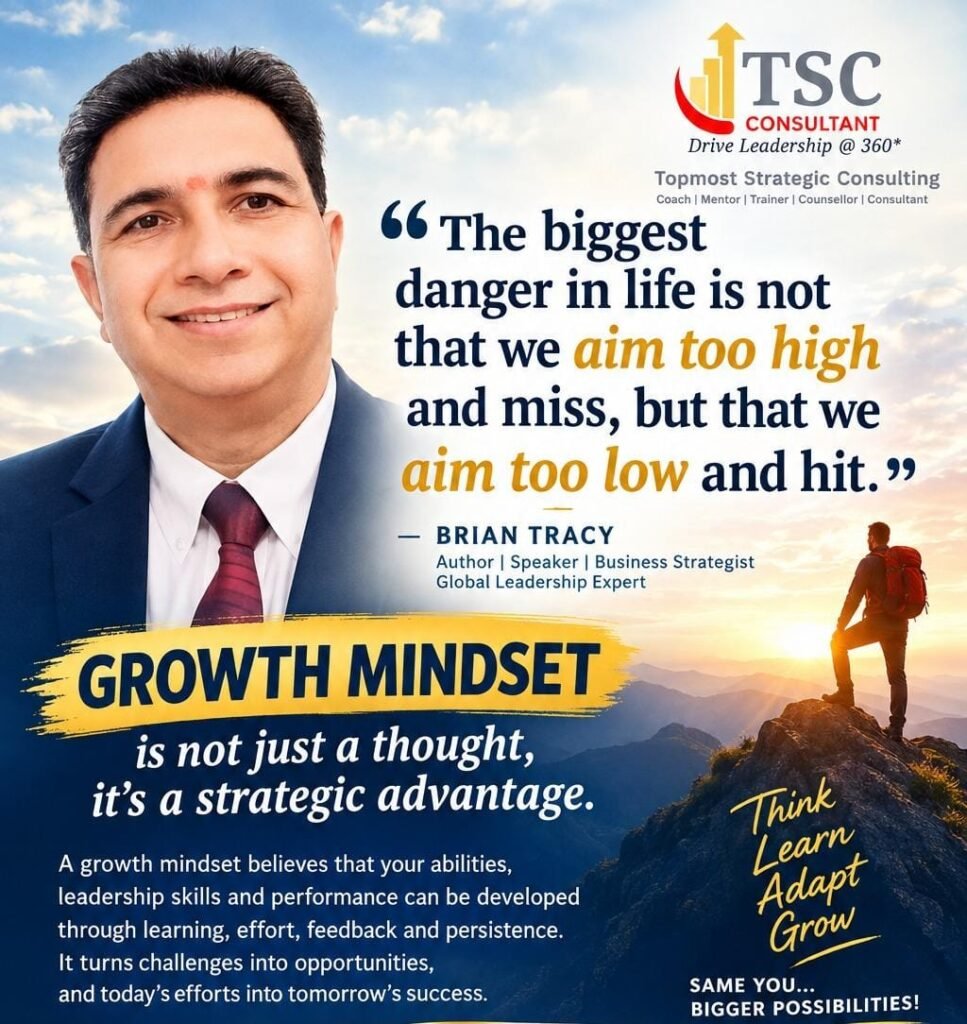
Why Psychotech Pro Leadership Is Growth Mindset @ 360°
Growth Mindset is not merely “thinking positively.” It is the disciplined belief and practice that abilities, leadership capability, relationships, performance and problem-solving capacity can be developed through learning, effort, feedback, experimentation and reflection.
For a Psychotech Pro Leader, growth mindset becomes more than a belief—it becomes a self-leadership vehicle: the mental operating system that converts “I have a problem” into “What can this problem teach me, and what can I do next?”
Psychotech Pro Leadership = Self-Awareness × Growth Orientation × Strategic Thinking × Intelligent Action
The objective is not to eliminate problems and challenges. It is to develop the capability to extract learning, create options and produce purposeful outcomes from them.
1. WHAT IS GROWTH MINDSET @ 360°?
A growth-oriented person does not assume:
“This is who I am.”
Instead, the question becomes:
“Who can I become through deliberate learning and practice?”
| Fixed Response | Psychotech Pro Growth Response |
|---|---|
| “I can’t do it.” | “I can’t do it yet.” |
| Failure = defeat | Failure = feedback |
| Criticism = threat | Feedback = information |
| Problem = obstacle | Problem = opportunity to learn |
| Difficulty = avoid | Difficulty = develop capability |
| Mistake = embarrassment | Mistake = data |
| Competitor = threat | Competitor = learning source |
| Change = disruption | Change = adaptation opportunity |
| Success = destination | Success = next level of development |
The critical distinction
Growth mindset does not mean believing everything is possible simply through positive thinking.
It means asking:
What is within my control? What can I learn? What can I improve? What experiment can I run? What help do I need? What should I change?
That makes growth mindset practical rather than motivational.
2. WHY IS GROWTH MINDSET THE CORE OF PSYCHOTECH PRO LEADERSHIP?
A leader’s external performance is strongly influenced by the quality of their internal response to reality.
The Psychotech Growth Cycle
Situation → Interpretation → Response → Action → Result → Feedback → Learning → Adaptation → Growth
The most powerful intervention occurs between Situation and Response.
For example:
Situation: Your team misses an important target.
A reactive leader may think:
“My team is incapable.”
A growth-oriented leader asks:
“What happened? What did we assume? Where did the process fail? What capability is missing? What should we change?”
The event has not changed.
The mental response has.
That is the essence of Psychotech leadership.
3. THE UNIQUE GROWTH MINDSET OF A PSYCHOTECH PRO LEADER
A Psychotech Pro Leader develops 8 growth capabilities.
1. Self-Awareness
Know your strengths, weaknesses, assumptions, emotions and habitual reactions.
Question:
“What am I not seeing about myself?”
2. Learning Agility
Learn quickly from new situations.
Question:
“What does this situation require me to learn?”
3. Resilience
Recover, rethink and restart after setbacks.
Question:
“What is my next constructive move?”
4. Adaptability
Change the method without abandoning the meaningful objective.
Question:
“What needs to change—my goal, strategy, skill or approach?”
5. Strategic Curiosity
Look beneath the obvious problem.
Question:
“What is really causing this?”
6. Feedback Intelligence
Use feedback without allowing it to damage self-worth.
Question:
“What part of this feedback can make me better?”
7. Experimentation
Test ideas rather than endlessly debating them.
Question:
“What small experiment can give me evidence?”
8. Continuous Improvement
Never become psychologically attached to yesterday’s success.
Question:
“How can I make this 1% better?”
4. PROBLEMS → OPPORTUNITIES: THE PSYCHOTECH SHIFT
The distinctive strength of a growth-oriented strategic mind is the ability to reframe without denying reality.
Use the P.O.W.E.R. Framework™:
| Step | Question |
|---|---|
| P — Pause | What exactly is happening? |
| O — Observe | What facts, emotions and assumptions are present? |
| W — Work out options | What are 3–5 possible responses? |
| E — Experiment | What is the smallest useful action I can test? |
| R — Reflect | What did I learn and what will I change? |
Example
Problem: Employee repeatedly misses deadlines.
Don’t immediately conclude:
“He is irresponsible.”
Instead investigate:
- Is the expectation clear?
- Is the workload realistic?
- Does the person have the required skill?
- Is there a resource constraint?
- Is accountability weak?
- Is there a motivation issue?
- Is the process itself defective?
Growth mindset converts judgment into diagnosis.
That is strategic leadership.
5. WHEN DO PSYCHOTECH LEADERS NEED GROWTH MINDSET MOST?
Growth mindset matters particularly during:
- Failure
- Career transitions
- Conflict
- Rejection
- Business uncertainty
- Organizational change
- Poor performance
- Criticism
- Financial setbacks
- Technology disruption
- Leadership pressure
- Relationship difficulties
- Personal mistakes
- Unexpected opportunities
The real test is not:
“Can I think positively when everything is going well?”
The real test is:
“Can I think constructively when reality does not go according to my plan?”
6. WHERE SHOULD GROWTH MINDSET BE APPLIED?
Personal Leadership
Health → habits → relationships → emotional regulation → learning → purpose
Professional Leadership
People → performance → communication → innovation → decision-making → execution
Strategic Leadership
Market change → competition → technology → customer expectations → uncertainty → opportunity
Social Leadership
Listening → empathy → collaboration → influence → trust → contribution
Growth mindset therefore operates at three levels:
I → We → World
I grow myself → We grow together → We create greater value.
7. FIVE STRATEGIC FRAMEWORKS TO MASTER GROWTH MINDSET
Framework 1: 5W + 1H Growth Questioning
Whenever facing a challenge:
- What exactly is happening?
- Why is it happening?
- Who is affected?
- Where is the opportunity?
- When should I act?
- How can I improve the situation?
This prevents emotional reaction from becoming premature action.
Framework 2: SWOT Your Mindset
| Strengths | Weaknesses |
|---|---|
| Existing skills | Blind spots |
| Experience | Limiting beliefs |
| Resources | Habitual reactions |
| Opportunities | Threats |
|---|---|
| Learning | Fear |
| Technology | Complacency |
| New relationships | Resistance to change |
The objective is not to create a perfect mindset.
It is to understand your current mindset and deliberately upgrade it.
8. 80/20 RULE: FIND THE HIGH-LEVERAGE GROWTH
Ask:
“Which 20% of my behaviours produce 80% of my growth?”
For many leaders, these may include:
- Deep listening
- Reading and learning
- Asking better questions
- Seeking feedback
- Taking responsibility
- Practising difficult skills
- Reflecting on experience
- Building relationships
Then ask:
“Which 20% of behaviours create 80% of my problems?”
Reduce those behaviours deliberately.
9. PDCA: TURN GROWTH INTO A DAILY HABIT
Growth mindset becomes powerful only when translated into behaviour.
PLAN → DO → CHECK → ACT
PLAN
What capability or outcome am I trying to improve?
DO
Take action.
CHECK
What happened?
ACT
Keep, modify or replace the approach.
Then repeat.
Growth = Experiment + Feedback + Adjustment + Repetition
10. PPF: POSSIBILITY → PATH → PERFORMANCE
A Psychotech Pro Leader should move through three questions:
POSSIBILITY
“What could become possible?”
PATH
“What route could take me there?”
PERFORMANCE
“What must I execute today?”
This prevents two extremes:
Dreaming without doing and doing without direction.
11. THE PSYCHOTECH GROWTH MINDSET EQUATION
A practical leadership equation can be expressed as:
Growth = Awareness × Learning × Practice × Feedback × Adaptation
If any factor becomes zero, growth is severely weakened.
For example:
Awareness without action = insight without transformation.
Action without reflection = activity without learning.
Feedback without openness = information without improvement.
Learning without practice = knowledge without capability.
12. THE DAILY PSYCHOTECH GROWTH ROUTINE
A leader can use five questions every evening:
- What did I learn today?
- What challenged me?
- Where did I react instead of respond?
- What will I do differently tomorrow?
- What capability am I developing through today’s experience?
This takes only a few minutes—but develops the habit of turning experience into intelligence.
13. THE ULTIMATE PSYCHOTECH PRO LEADER SHIFT
The deepest transformation is from:
Victim → Owner
Problem → Possibility
Failure → Feedback
Fear → Investigation
Criticism → Learning
Uncertainty → Experimentation
Comfort → Development
Knowledge → Practice
Experience → Wisdom
Success → Next Growth Challenge
That is why Growth Mindset is not one component of Psychotech Pro Leadership. It is the engine that keeps the entire leadership system developing.
THE PSYCHOTECH PRO GROWTH MINDSET MANTRA
“I cannot control every situation.
I can control how I understand it,
how I respond to it,
what I learn from it,
and what I do next.”
A Psychotech Pro Leader therefore does not ask only:
“How do I solve this problem?”
The more powerful question is:
“How can this problem develop me, develop my people, improve my strategy and create a better future?”
The ultimate formula
SELF-AWARENESS → GROWTH MINDSET → STRATEGIC THINKING → INTELLIGENT ACTION → FEEDBACK → ADAPTATION → PURPOSEFUL GROWTH
Master your mind.
Convert challenges into learning.
Convert learning into capability.
Convert capability into strategic action.
Convert action into purposeful growth.
That is Growth Mindset @ 360°—and that is the Psychotech Pro Leadership way.

ANUPAMM SHARMA
PSYCHOTECH™ PRO STRATEGIST
COACH I MENTOR I TRAINER
COUNSELLOR I CONSULTANT