

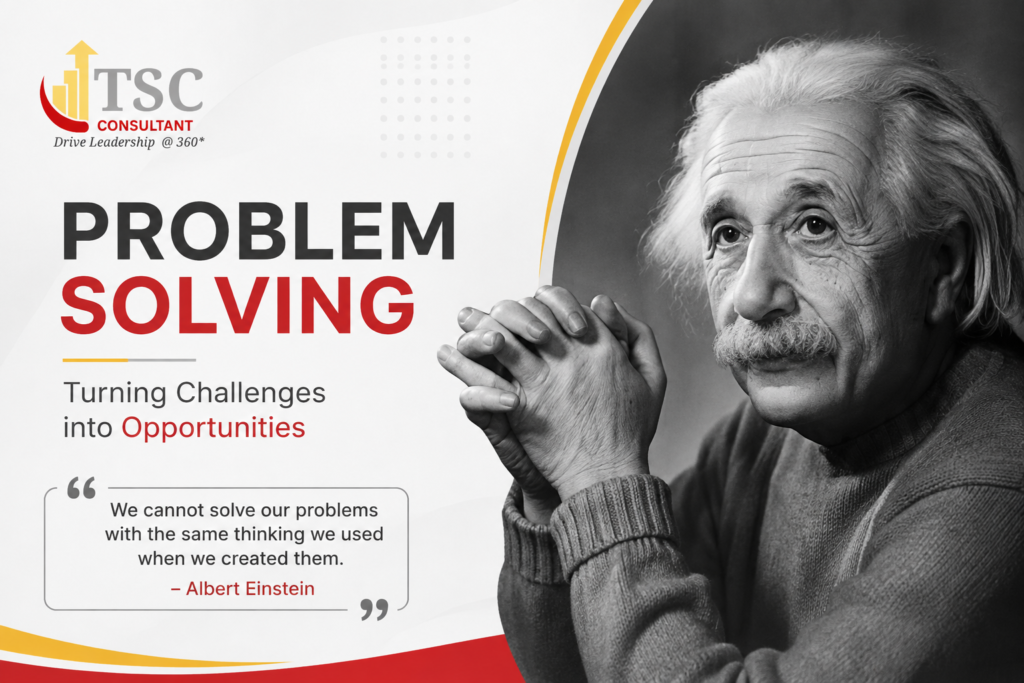
PROBLEM SOLVING: The Ultimate Human Superpower for Success in the AI Era
“Every problem is a disguised opportunity. The quality of your life is determined by the quality of problems you solve.”
In today’s rapidly evolving world, artificial intelligence can process billions of data points in seconds, yet one human capability remains irreplaceable—the ability to solve meaningful problems with wisdom, creativity, emotional intelligence, and strategic thinking.
History remembers individuals not because they avoided problems but because they solved problems that transformed humanity.
Whether it is business, leadership, relationships, career growth, health, innovation, or entrepreneurship, every breakthrough begins with identifying a problem and designing an effective solution.
Problem solving is not merely a skill.
It is a way of thinking.
It is a mindset.
It is a life philosophy.
It is one of the most valuable competencies of the 21st century.
What is Problem Solving?
Problem solving is the systematic process of identifying, understanding, analyzing, and resolving obstacles that prevent us from achieving desired goals.
It involves logical reasoning, creativity, emotional regulation, decision-making, experimentation, learning, and continuous improvement.
In simple words,
Problem Solving = Moving from Current Reality to Desired Reality.
Every successful person is essentially a professional problem solver.
Definition
Problem solving is the disciplined ability to recognize challenges, diagnose root causes, generate effective alternatives, evaluate consequences, implement solutions, and continuously improve outcomes through learning and adaptation.
Why is Problem Solving Important?
Every aspect of life is filled with challenges.
- Businesses solve customer problems.
- Doctors solve health problems.
- Teachers solve learning problems.
- Engineers solve technical problems.
- Parents solve family problems.
- Leaders solve organizational problems.
- Entrepreneurs solve market problems.
Income, influence, leadership, and impact increase in direct proportion to the value of problems you can solve.
The marketplace rewards problem solvers.
The Psychology of Problems
Human beings naturally resist problems because the brain seeks comfort and certainty.
However, neuroscience reveals that solving challenging problems strengthens neural pathways responsible for:
- Critical thinking
- Cognitive flexibility
- Creativity
- Emotional regulation
- Decision making
- Memory
- Confidence
- Resilience
Every solved problem literally rewires the brain toward higher capability through neuroplasticity.
Types of Problems
Understanding the nature of the problem determines the appropriate solution.
1. Personal Problems
- Self-doubt
- Habits
- Time management
- Health
- Stress
- Confidence
2. Professional Problems
- Team conflicts
- Productivity
- Leadership
- Communication
- Deadlines
- Customer complaints
3. Strategic Problems
- Market competition
- Innovation
- Business growth
- Digital transformation
- Organizational change
4. Technical Problems
- Software
- Engineering
- Manufacturing
- Process failures
5. Adaptive Problems
These require changing people’s beliefs, culture, or behaviors rather than applying a technical fix.
Examples include organizational culture, employee engagement, or societal change.
Who Needs Problem Solving?
The simple answer is everyone.
Students solve learning challenges.
Employees solve operational challenges.
Managers solve team challenges.
Leaders solve strategic challenges.
Parents solve family challenges.
Entrepreneurs solve customer challenges.
Governments solve societal challenges.
Every profession rewards superior problem-solving ability.
When Should We Apply Problem Solving?
Not only when crises arise.
Problem solving should become a daily habit.
Apply it when:
- Goals are unclear.
- Performance declines.
- Conflicts arise.
- Opportunities emerge.
- Innovation is required.
- Risks increase.
- Decisions become complex.
- Customer expectations change.
The best organizations solve tomorrow’s problems before competitors recognize them.
Where Can Problem Solving Be Applied?
Everywhere.
Personal life.
Career.
Business.
Education.
Healthcare.
Government.
Sports.
Relationships.
Finance.
Technology.
Artificial Intelligence.
Innovation.
Leadership.
Community development.
Nation building.
The scope is limitless.
The Complete Problem-Solving Framework
Step 1: Clearly Define the Problem
Never solve the wrong problem.
Ask:
- What exactly is happening?
- What should be happening?
- What is the gap?
Albert Einstein reportedly emphasized that if he had one hour to solve a problem, he would spend most of it understanding the problem before attempting a solution.
Step 2: Gather Facts
Avoid assumptions.
Collect:
- Data
- Observations
- Feedback
- Evidence
- Customer insights
- Performance reports
Facts reduce emotional bias.
Step 3: Identify Root Causes
Symptoms are not causes.
Use tools like:
- Five Whys
- Fishbone Diagram
- Pareto Analysis
- Process Mapping
Treat the disease—not merely its symptoms.
Step 4: Generate Alternatives
Creativity matters.
Brainstorm without judgment.
Encourage diverse viewpoints.
Quantity often leads to quality.
Step 5: Evaluate Solutions
Consider:
- Cost
- Risk
- Feasibility
- Time
- Resources
- Impact
- Sustainability
Choose the option with the greatest long-term value.
Step 6: Take Action
Execution transforms ideas into results.
Many people know solutions.
Few implement them consistently.
Action creates momentum.
Step 7: Measure Results
Ask:
Did the solution work?
How do we know?
Which metrics improved?
Continuous measurement prevents recurring problems.
Step 8: Learn and Improve
Every solution generates new knowledge.
Document lessons.
Improve processes.
Share learning.
Create systems that prevent recurrence.
Continuous improvement builds organizational excellence.
Seven Essential Thinking Skills
Analytical Thinking
Breaking complex problems into manageable parts.
Critical Thinking
Questioning assumptions and evaluating evidence objectively.
Creative Thinking
Generating innovative possibilities beyond conventional answers.
Systems Thinking
Understanding interconnections rather than isolated events.
Strategic Thinking
Considering long-term consequences and competitive advantage.
Design Thinking
Starting with empathy, defining needs, ideating, prototyping, and testing solutions.
Computational Thinking
Decomposing problems, recognizing patterns, abstracting key elements, and designing repeatable processes.
Together, these thinking styles create a powerful problem-solving toolkit.
Common Barriers
People often fail to solve problems because of:
- Fear of failure
- Emotional reactions
- Confirmation bias
- Poor communication
- Lack of data
- Rigid thinking
- Overconfidence
- Analysis paralysis
- Short-term thinking
Recognizing these barriers is the first step toward overcoming them.
Problem Solving in Personal Life
Daily life presents countless opportunities to practice.
Improve health by identifying habits rather than relying on motivation alone.
Strengthen relationships by understanding underlying needs instead of reacting to conflicts.
Manage finances by addressing spending behaviors and long-term planning.
Develop discipline by designing systems instead of depending on willpower.
Personal mastery begins with solving recurring life problems systematically.
Problem Solving in Professional Life
Organizations thrive when employees think beyond tasks.
High-performing professionals:
- Anticipate risks.
- Improve processes.
- Eliminate waste.
- Reduce costs.
- Increase customer satisfaction.
- Build collaborative teams.
- Drive innovation.
Leaders are judged less by how many answers they possess and more by how effectively they enable teams to solve important problems.
Problem Solving in the AI Era
Artificial intelligence excels at:
- Data analysis
- Pattern recognition
- Automation
- Prediction
- Optimization
Humans excel at:
- Ethical judgment
- Creativity
- Empathy
- Purpose
- Context
- Leadership
- Negotiation
- Value-based decisions
The future belongs to professionals who combine AI with human wisdom rather than competing against it.
Daily Practices to Master Problem Solving
Mastery grows through deliberate practice.
- Keep a daily problem-solving journal.
- Ask “Why?” at least five times before accepting an explanation.
- Read case studies from diverse industries.
- Practice brainstorming multiple solutions for everyday challenges.
- Learn from failures without assigning blame.
- Engage in debates that challenge your assumptions.
- Use decision matrices for significant choices.
- Reflect weekly on one problem you solved and one lesson learned.
- Study successful leaders and innovators to understand their thinking processes.
- Collaborate with people who bring different perspectives.
Consistent practice gradually transforms problem solving from a technique into a natural habit.
Leadership and Problem Solving
Great leaders do not create followers.
They develop problem solvers.
They ask empowering questions such as:
- What evidence supports this?
- What assumptions are we making?
- What alternatives have we considered?
- What risks remain?
- What can we learn if this fails?
Questions stimulate ownership, curiosity, and innovation.
Measuring Problem-Solving Excellence
Assess yourself regularly.
Can you:
- Define problems precisely?
- Control emotions under pressure?
- Find root causes?
- Generate multiple options?
- Make timely decisions?
- Learn from mistakes?
- Improve systems continuously?
- Help others solve problems?
Progress in these areas signals growing mastery.
A 30-Day Practice Plan
Week 1: Focus on observing and defining problems accurately.
Week 2: Practice root-cause analysis using tools such as the Five Whys and Pareto thinking.
Week 3: Generate multiple solution options, evaluate trade-offs, and implement small experiments.
Week 4: Review outcomes, capture lessons learned, refine your approach, and teach one problem-solving technique to someone else. Teaching reinforces mastery.
Key Principles to Remember
- Every problem carries the seed of opportunity.
- Correct diagnosis is more valuable than a quick answer.
- Root causes matter more than symptoms.
- Multiple perspectives improve solution quality.
- Small experiments reduce risk.
- Consistent execution beats perfect planning.
- Reflection transforms experience into wisdom.
- Great problem solvers become trusted leaders.
Conclusion
Problem solving is not simply a professional competency—it is a lifelong discipline that shapes character, leadership, and contribution.
In a world where technology continues to automate routine tasks, the greatest competitive advantage will belong to individuals who can think clearly, adapt quickly, collaborate effectively, and solve meaningful human problems.
Every challenge you encounter is an invitation to grow stronger, wiser, and more capable.
Do not ask, “Why is this problem happening to me?”
Instead ask:
“What is this problem teaching me, and how can solving it create greater value for myself and others?”
That single shift in perspective transforms obstacles into opportunities, uncertainty into innovation, and ordinary individuals into exceptional leaders.
Remember: Success does not come to those who avoid problems. Success comes to those who consistently solve the right problems, in the right way, for the right people.

ANUPAM SHARMA
PSYCHOTECH™ PRO STRATEGIST
COACH I MENTOR I TRAINER
COUNSELLOR I CONSULTANT