
Mastering the Art of Priority: A Corporate Primer on Psychotech Leadership
In boardrooms and strategy offsites, leaders are often handed a buffet of options—new markets, product bets, organizational restructures, technology investments. The assumption is simple: more options equal better outcomes. Reality is less flattering. Organizations that surge ahead don’t do so because they had more choices; they succeed because they prioritized the right ones and executed without distraction.
Priority is the invisible force behind every measurable result. For corporate leaders, mastering prioritization is not a soft skill or a time-management trick. It is the architecture of sustained competitive advantage. This primer outlines a repeatable Psychotech approach—where psychology and technology align—to convert noise into high-impact action, accelerate learning, and drive strategic outcomes across organizations.
Why prioritization matters now
Two systemic changes make prioritization urgent for today’s corporates:
- Information overload: Data inflow has exploded. The problem isn’t scarcity of inputs; it’s scarcity of meaningful filters.
- Speed and complexity: Decisions must be faster yet robust enough to withstand market volatility and ethical scrutiny.
When you don’t prioritize, you create three costly dynamics: cognitive fatigue at the top, misaligned execution in the middle, and wasted capital at the portfolio level. Prioritization is the antidote—compressing complexity into focused bets that amplify learning and value creation.
The Decision Pyramid: A practical mental model
Avoid treating inputs as equals. The Decision Pyramid organizes thinking into five hierarchical layers that filter raw inputs into decisions that serve purpose.
- Vision: The North Star—clarifies what winning looks like in three-to-five-year terms.
- Decision: The execution endpoint—what you commit to do now.
- Prioritization: Where leaders spend most time—ranking options by impact.
- Choices: The set of viable paths to consider.
- Information: Raw data and signals to feed the system.
Leaders who operate primarily at the prioritization layer prevent “activity” from masquerading as “effectiveness.” The job is to ensure only choices that align with vision ascend to the decision layer.
Defining Psychotech Leadership for corporates
Psychotech leadership intentionally fuses human judgment with technological leverage to create a Decision Engine that scales. It is not automation for automation’s sake. It is the design of systems that surface the right signals and amplify human values.
Psychology strengths: vision, ethics, stakeholder empathy, creativity, contextual judgement.
Technology strengths: rapid data processing, predictive modeling, scenario simulation, repeatable workflows.
Use case: a global product portfolio review that combines sentiment analysis across customer feedback (tech) with executive debate about brand positioning and risk appetite (psychology) produces smarter, faster pruning of low-value SKUs and reallocation of R&D.
The science + art of ranking
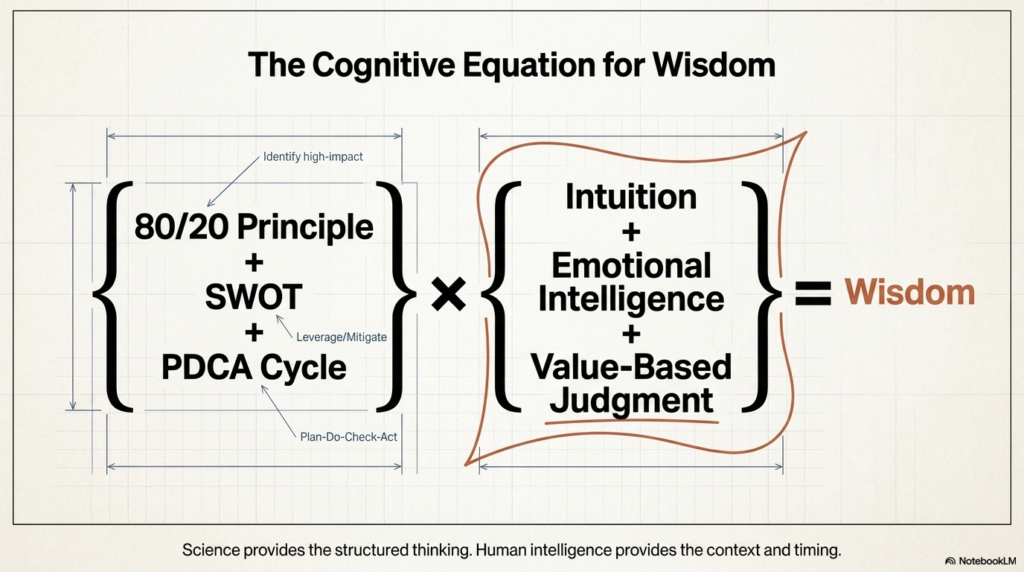
Effective prioritization blends scientific rigor with human wisdom.
The Science (structured frameworks)
- Pareto (80/20): Identify the 20% of initiatives likely to deliver 80% of strategic value.
- SWOT and strategic mapping: Use these to expose where leverage sits and where to defend.
- PDCA: Run short learning cycles to validate assumptions and refine priorities.
The Art (judgment and timing)
- Contextual sense-making: Read cultural dynamics and market sentiment that models miss.
- Moral calibration: Choose initiatives that are not only profitable but reputation-safe.
- Timing intuition: Know when to press, pause, or pivot.
Corporate leaders must wear both hats—use models to surface candidates and judgment to select winners.
Spotting the Priority Trap
Corporate environments create incentives that invite the Priority Trap—meeting inflation, project proliferation, and a bias for “doing” rather than sequencing. Common symptoms:
- FOMO-driven investment in every promising startup or trend.
- Over-commitment to pet projects with low ROI.
- Analysis paralysis: endless studies that delay decisive moves.
Escaping the trap begins with explicit rules and ruthless trade-offs. Your role is to institutionalize these limits so teams don’t default to activity.
The 7-step Mastery System (applied to corporate leaders)
- Define Your North Star: Translate corporate vision into measurable outcomes (e.g., market share, margin targets, innovation metrics). Communicate this with crisp guardrails.
- List All Choices: Convene a rapid “brain dump” of strategic initiatives across functions—M&A targets, product bets, GTM experiments.
- Apply the 80/20 Filter: Use quantitative scoring to isolate initiatives likely to deliver disproportionate impact on your North Star.
- Filter with the 5-D Psychotech Model: Evaluate each initiative on Purpose (alignment), Impact (value), Urgency (timing), Energy (resource intensity), and Leverage (scalability).
- Eliminate Ruthlessly: Publicly shelve or kill projects that fail threshold tests. Normalize “no” as a strategic capability.
- Sequence Actions: Create a 90–180 day roadmap that sequences proof-of-concept, scale, and resource allocation. Think in learning stages—probe, validate, scale.
- Review with PDCA: Schedule frequent micro-reviews (weekly dashboards, monthly strategy reviews, quarterly portfolio rebalancing) to iterate based on outcomes.
Practical tools and templates
- Executive Prioritization Scorecard: columns for North Star alignment, expected value, probability of success, resource cost, time to impact, and ethical risk. Rank and select.
- Rapid Experiment Protocol: defined hypothesis, success metric, timeline (30–90 days), budget cap, and decision gate.
- Decommission Checklist: criteria for sunsetting initiatives (e.g., sustained negative delta to target, waning engagement, unresolvable technical debt).
Daily rituals for leadership leverage
Consistency wins. Make prioritization a habit at the individual and organizational level.
- Morning Priority Ritual (10 mins): Top 3 priorities tied to the North Star; one delegation and one escalation item.
- Midday Check (5 mins): Quick audit—are you in Growth Zone or Noise Zone? Re-align or reassign.
- Evening Reflection (10 mins): Identify the single highest-value action from the day and the biggest distractor. Note one action to eliminate tomorrow.
At the team level, embed 5-minute stand-ups focused on priority alignment and a weekly “what to stop” agenda item.
Leading teams to prioritize: governance and culture
Systems without culture fail. To scale Psychotech prioritization:
- Create a governance cadence: Clear decision rights, review forums, and escalation paths.
- Reward the right behaviors: Incentivize focus, learning, and voluntary decommissioning.
- Train judgment: Run simulation-based workshops to practice ethical and strategic trade-offs.
- Make information accessible: Invest in dashboards that highlight impact metrics, not vanity metrics.
Technology as an amplifier, not a crutch
Use AI and analytics to accelerate filtering and learning:
- Signal triage: Automate low-sensitivity alerts so human attention focuses on high-sensitivity anomalies.
- Scenario simulation: Run fast what-if models to stress-test priorities under alternative market conditions.
- Knowledge synthesis: Use summarization tools to convert meeting outcomes into action items and decision logs.
Guardrails: keep humans accountable for value judgments and ethics; use tech to increase signal-to-noise and execution speed.
Case vignette: Portfolio pruning that worked
A multinational CPG company faced slowing growth and a bloated SKU base. Leadership applied the 7-step Mastery System:
- North Star: 3% organic revenue growth and 200 bps margin expansion.
- Brain dump: 300 SKUs across regions.
- 80/20 and 5-D filter: Reduced to 45 SKUs that matched brand differentiation and margin targets.
- Sequence: 90-day trials in two markets, scale in 12 months.
Result: Rapid margin improvement, simplified supply chain, and redirected R&D into higher-potential products.
Common objections and how to answer them
- “We can’t kill projects; what if we miss an opportunity?” Counter: Controlled experiments with kill criteria reduce missed bets while preventing resource hemorrhage.
- “Our teams will resist elimination.” Counter: Tie incentives to portfolio outcomes and create safe forums to propose replacements for cancelled items.
- “Models miss nuance.” Counter: Combine models with decision forums where leaders bring context and moral judgment.
Implementation checklist for the next 90 days
- Clarify North Star metrics and publish them company-wide.
- Run a 2-day portfolio sprint to list and score top 50 initiatives.
- Build an Executive Prioritization Scorecard and select the top 5 bets for the next 90 days.
- Institute the daily priority rituals for the executive team and one weekly “stop” agenda item.
- Deploy one tech tool for signal triage and a simple dashboard for outcome tracking.
- Schedule a quarterly PDCA review to iterate the process.
Closing: Become a Decision Architect
Moving from decision maker to Decision Architect changes the scale of your impact. It shifts your role from reacting to designing systems that surface high-value choices and suppress distractions. This is the essence of Psychotech leadership: human judgment guided by technological clarity, engineered into repeatable governance.
Prioritization isn’t a productivity hack—it’s the strategic discipline that structures where the firm invests attention, energy, and capital. In an era of boundless options, purposeful ranking is power. Start by designing a Decision Engine that your organization can run on autopilot: clear North Star, ruthless filters, repeatable learning cycles, and tech that amplifies—never replaces—human values.
Quick next steps
- Share the North Star and governance cadence with your leadership team this week.
- Run the portfolio sprint within 30 days.
- Adopt the daily priority rituals and the 7-step Mastery System across one pilot business unit.
Discipline in prioritization compounds. When practiced consistently, it turns choices into leverage and leaders into architects of sustained advantage. Would you like a templated Executive Prioritization Scorecard and the Rapid Experiment Protocol in a downloadable format to pilot this in your company?