
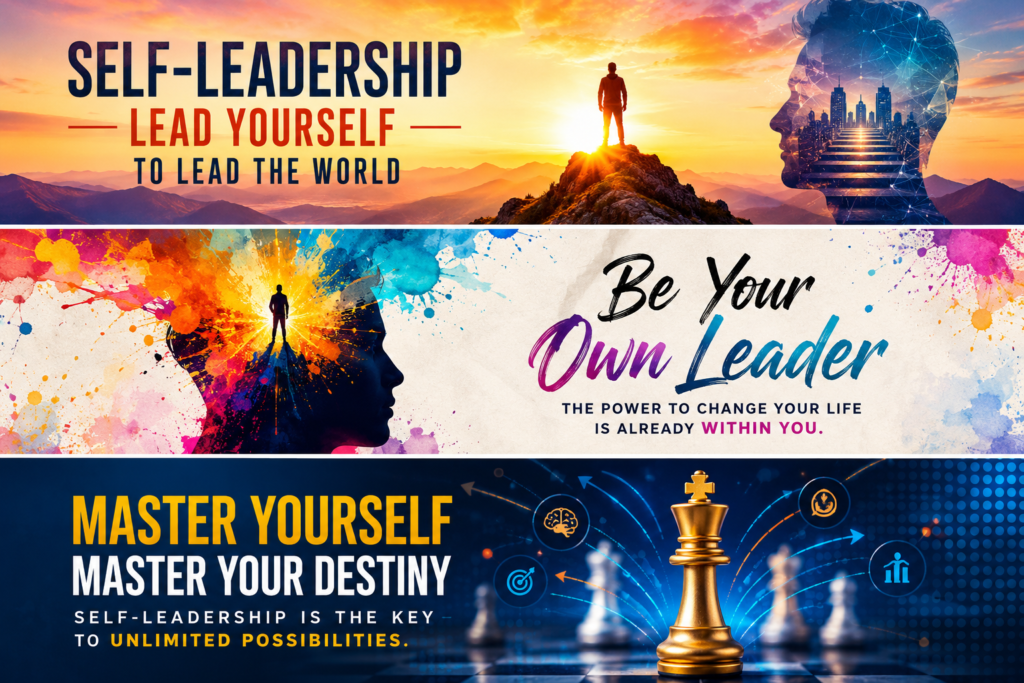
SELF-LEADERSHIP: The Ultimate Human Operating System for Peak Performance in the AI Era
Why the Greatest Leader You Will Ever Follow Is the Person You See in the Mirror
“You cannot consistently outperform the quality of your own leadership.” — Psychotech Principle #1
Artificial Intelligence is transforming industries.
Automation is reshaping careers.
Organizations are reinventing themselves at unprecedented speed.
Yet amid this technological revolution, one timeless truth remains unchanged:
The quality of your life will never exceed the quality of your self-leadership.
Before you can lead a team, inspire an organization, build a business, influence a nation, or transform society, you must first master the most challenging leadership assignment of all—leading yourself.
At Psychotech, we define self-leadership as far more than motivation or self-discipline. It is the Human Operating System (HOS) that integrates your psychology, purpose, emotions, intelligence, habits, and actions into one coherent direction. It is the invisible architecture that determines whether your potential remains dormant or becomes extraordinary performance.
The greatest leaders in history—from entrepreneurs and scientists to reformers and statesmen—did not simply command others. They first developed the ability to command themselves.
That is the true essence of self-leadership.
Why Self-Leadership Is the Ultimate Competitive Advantage
The modern workplace no longer rewards only technical expertise. Knowledge is abundant, AI can generate information instantly, and automation can execute repetitive tasks with remarkable efficiency.
What organizations increasingly value are people who can:
- Think independently.
- Learn continuously.
- Adapt rapidly.
- Make sound decisions under uncertainty.
- Manage emotions effectively.
- Take ownership without supervision.
- Inspire confidence through consistent action.
These are not technical skills.
They are self-leadership skills.
In the AI era, technology multiplies capability, but self-leadership determines direction.
Without self-leadership, intelligence becomes scattered, talent remains underutilized, and opportunities pass unnoticed.
What Is Self-Leadership?
Psychotech defines self-leadership as:
The conscious ability to design, direct, regulate, and continuously improve your thoughts, emotions, decisions, behaviors, and habits in alignment with your life’s purpose.
It is becoming both the architect and the CEO of your own life.
Imagine your life as an organization.
Your mind is the strategy department.
Your emotions are the organizational culture.
Your habits are operational systems.
Your values are governance.
Your purpose is the corporate vision.
Your decisions are investments.
Your actions are execution.
The CEO of this organization is you.
If the CEO lacks clarity, discipline, or vision, the entire organization suffers. Likewise, if your internal leadership is weak, no external opportunity can fully compensate.
The Psychotech Self-Leadership Model
At Psychotech, self-leadership is viewed as the integration of five powerful dimensions.
1. Psychological Leadership
Everything begins in the mind.
Your beliefs influence your thinking.
Your thinking shapes your decisions.
Your decisions create your habits.
Your habits define your destiny.
The first responsibility of a self-leader is mastering internal dialogue.
2. Strategic Leadership
Successful people do not merely react.
They anticipate.
They prioritize.
They allocate energy wisely.
They focus on high-impact activities rather than remaining busy with low-value tasks.
Strategic thinking converts effort into meaningful progress.
3. Emotional Leadership
Pressure reveals leadership.
Emotionally intelligent individuals remain composed during uncertainty.
They transform criticism into learning.
Failure into feedback.
Stress into strength.
Resilience is not avoiding adversity.
It is learning how to grow because of adversity.
4. Behavioral Leadership
Knowledge alone changes nothing.
Consistent execution changes everything.
Self-leaders develop routines that support excellence.
Small disciplined actions repeated every day eventually outperform occasional bursts of motivation.
5. Purpose Leadership
Purpose provides meaning.
Without purpose, discipline weakens.
Without purpose, motivation disappears.
Without purpose, success feels empty.
Purpose transforms ordinary work into extraordinary contribution.
The Eight Psychotech Principles of Self-Leadership
Traditional leadership literature often refers to the “8 Cs.” Psychotech expands these into practical leadership behaviors.
Confidence
Confidence grows through preparation, competence, and repeated execution—not wishful thinking.
Calmness
Calm minds make better decisions.
Emotional stability is a strategic asset.
Clarity
Clarity removes confusion.
Clear priorities produce focused execution.
Curiosity
Curiosity drives innovation.
Every breakthrough begins with a meaningful question.
Compassion
Strong leaders understand both themselves and others.
Self-compassion creates resilience rather than self-criticism.
Courage
Leadership always involves uncertainty.
Courage is acting wisely despite fear.
Creativity
Creativity combines imagination with disciplined problem-solving.
Innovation begins when conventional thinking ends.
Connectedness
True self-leadership never isolates.
It strengthens relationships, collaboration, and collective growth.
Why Most People Never Reach Their Potential
Potential is rarely limited by intelligence.
It is usually limited by internal barriers such as:
- Fear of failure.
- Lack of consistency.
- Poor emotional regulation.
- Dependence on external motivation.
- Comfort-zone thinking.
- Decision paralysis.
- Procrastination.
- Absence of purpose.
These challenges are psychological before they become professional.
Master the psychology, and performance follows.
The Psychotech Leadership Equation
Self-Awareness × Purpose × Emotional Intelligence × Strategic Thinking × Discipline × Consistent Execution = Sustainable High Performance
If any component approaches zero, overall performance declines dramatically.
Leadership is not a collection of isolated skills.
It is an integrated operating system.
Building Self-Leadership: The Psychotech Framework
Developing self-leadership requires intentional practice.
Begin with these daily disciplines:
- Reflect on your decisions before blaming circumstances.
- Replace excuses with ownership.
- Set priorities before checking notifications.
- Learn something valuable every day.
- Maintain emotional composure during challenges.
- Seek feedback instead of validation.
- Celebrate progress rather than perfection.
- Build habits stronger than temporary motivation.
- Review your purpose every morning.
- End each day by asking, “Did my actions reflect the leader I aspire to become?”
Small improvements compounded over time create extraordinary transformation.
Self-Leadership in Organizations
Organizations do not become excellent by accident.
They become excellent when individuals consistently demonstrate ownership, initiative, accountability, and disciplined execution.
Employees with strong self-leadership:
- Require less supervision.
- Solve problems proactively.
- Build trust quickly.
- Strengthen organizational culture.
- Inspire colleagues through example.
- Adapt effectively during change.
- Improve customer experiences.
- Increase innovation and productivity.
The most valuable employees are often those who manage themselves exceptionally well.
The AI Era Demands Self-Leaders
Artificial Intelligence will continue changing jobs, industries, and business models.
However, AI cannot replace:
- Character.
- Integrity.
- Wisdom.
- Purpose.
- Empathy.
- Ethical judgment.
- Human courage.
- Personal responsibility.
These qualities define authentic leadership.
Technology will continue evolving.
Human self-leadership will remain the ultimate differentiator.
Your Daily Self-Leadership Challenge
Every morning, ask yourself five powerful questions:
- What is my highest-value contribution today?
- What challenge requires courage?
- Which habit deserves my attention?
- How will I create value for others?
- At day’s end, will I be proud of today’s decisions?
These questions gradually transform thinking into intentional leadership.
Final Reflection: Become the CEO of Your Own Life
Leadership is not granted by a title.
It is demonstrated through daily choices.
Every thought you nurture, every decision you make, every emotion you regulate, and every habit you reinforce is either strengthening or weakening your leadership capacity.
The world does not merely need more managers, executives, or influencers.
It needs individuals capable of mastering themselves before attempting to influence others.
At Psychotech, we believe that self-leadership is the first operating system every human must install before mastering business, technology, relationships, or society.
When you lead yourself with clarity, purpose, discipline, emotional intelligence, and strategic thinking, you do more than achieve goals—you become a force for positive transformation.
Lead your mind.
Master your emotions.
Discipline your actions.
Align with your purpose.
Create your legacy.
Because the greatest organization you will ever lead is not a company.
It is your own life.
This article establishes the Psychotech philosophy rather than presenting conventional leadership advice. It introduces a distinctive framework—the Human Operating System (HOS)—and positions self-leadership as the foundational capability for thriving in the AI era. It is suitable for publication on your website, LinkedIn, Medium, or as the basis for a keynote or training module.

ANUPAM SHARMA
PSYCHOTECH™ STRATEGIST
COACH I MENTOR I TRAINER
COUNSELLOR I CONSULTANT