
Orchestrating Habits: The Silent Engine Behind Peak Performance
“We are what we repeatedly do. Excellence, then, is not an act, but a habit.” – Aristotle
I. Introduction: The Symphony of Habit and Leadership
In the world of high-stakes leadership, massive strategies and million-dollar decisions often overshadow a quiet but powerful force—habits. The phrase “Leadership is orchestrating habits” recognizes that truly impactful leaders don’t just issue orders or set visions; they shape cultures of consistent action, discipline, and behavioral rhythm. In essence, leaders mold and master habits—both their own and those of their teams.
II. Why Habits Matter in Leadership, Productivity & Peak Performance
Modern research reveals that up to 43% of daily behavior is driven by habits, not active decision-making (Duke University, MIT, Stanford). That means nearly half of your workday, your focus, your health, your meetings—even your leadership style—is rooted in subconscious behavioral loops.
Why habits are pivotal:
- Habits conserve cognitive energy (prefrontal cortex offloading)
- They create consistent execution without needing daily motivation
- They shape culture: Teams mimic leader’s micro-habits
- They drive identity and trust: “Reliable leaders” are consistent leaders
- They impact ROI: High-performing leaders embed success habits in systems
Graph Insight:
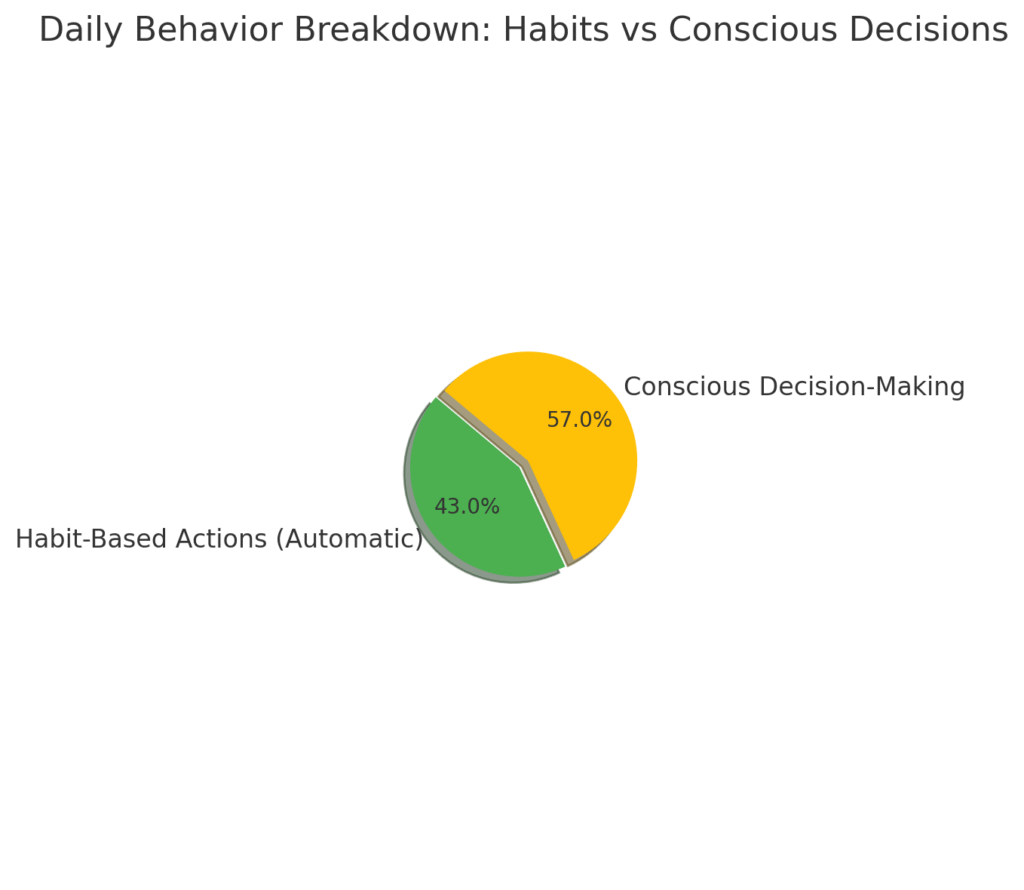
Above, a pie chart illustrates how almost half of our actions are habitual, functioning below conscious awareness. This underscores the need for purposeful habit design in leadership development.
III. Understanding the Habit Loop: Cue, Routine, Reward
Borrowed from Charles Duhigg’s research (Harvard Business Review, “The Power of Habit”), the Habit Loop is made up of:
- Cue – The trigger that initiates the behavior (e.g., stress)
- Routine – The behavior itself (e.g., procrastinating)
- Reward – The benefit your brain receives (e.g., relief)
This loop, repeated over time, becomes neurologically encoded in the basal ganglia, forming deep-rooted patterns. Leaders must understand this loop to break unproductive habits and install empowering ones.
IV. Can We Learn & Unlearn Habits Frequently?
Yes—but it’s not just willpower or motivation. The science of neuroplasticity shows that:
- Old habits never fully erase; they’re overridden by stronger patterns.
- Consistency & trigger replacement are key to habit change.
- Environment, identity shifts, and accountability accelerate reprogramming.
Neuroscientific studies from Stanford and MIT confirm that habit formation involves a shift from goal-directed behavior to automatic execution once a critical repetition threshold is met (~66 days on average—UCL research).

V. The 7-Step Habit Empowerment Framework for Leaders
Here is a research-backed model to help leaders identify, redesign, and institutionalize habits:
H.A.B.I.T.S.™ Framework
H – Highlight Patterns:
Track energy zones, peak hours, emotional triggers, productivity dips (Use habit tracker apps or journaling).
A – Audit Impact:
Which habits add or subtract value? Leverage the 80/20 Principle—which 20% of habits yield 80% of your outcomes?
B – Break & Replace:
Use the “Golden Rule of Habit Change”: Don’t erase a bad habit—replace the routine, retain the cue & reward.
I – Install Keystone Habits:
Focus on identity-forming habits like morning rituals, planning, exercise, or gratitude. (Harvard found exercise is a keystone habit that boosts productivity, positivity & team trust.)
T – Track & Tweak:
Use data—feedback loops, time audits, and behavioral journaling—to course-correct.
S – Scale Through Systems:
Embed habits in rituals, routines, tools, and culture. Leaders scale their habits via delegation, automation, and accountability systems.
VI. Habit Analysis Cycle: Identify → Rectify → Amplify
| Stage | Description | Tool/Framework |
|---|---|---|
| 1. Identify | Observe recurring behaviors & outcomes | Journaling, Time audit, Trigger logs |
| 2. Rectify | Replace poor habits with productive ones | Habit Loop replacement model |
| 3. Amplify | Systematize high-value habits | Keystone Habits, Digital workflows, Delegation |
VII. Global Practices & Insights: Harvard, Stanford, Yale, MIT
Harvard Business School (HBS)
Emphasizes daily reflection journaling as a leadership habit—leaders who journal daily showed 20% higher strategic clarity.
Stanford
James March’s work: Organizations reflect the habits of their leaders. Leader’s consistent routines directly shape cultural resilience.
MIT Media Lab
Behavioral design and AI integration in productivity habits. Tools like RescueTime and Habitica are gamifying behavior change.
Yale School of Management
Research shows that habit-based leadership training improved employee engagement by 35% over strategy-only training.
VIII. Real-World Applications of Habit-Oriented Leadership
| Domain | Leader Habit | Result |
|---|---|---|
| Satya Nadella | Daily learning & reflection | Transformed Microsoft’s growth culture |
| Angela Merkel | Quiet morning planning ritual | Effective crisis leadership |
| Jeff Bezos | “Two Pizza Rule” for meetings | Productivity + Decentralized decision-making |
| Naval Ravikant | Mental models, reading habit | Intellectual capital growth |
IX. From Habit Formation to Organizational Culture
Leaders don’t rise to the level of vision. They fall to the level of their systems—and habits are the smallest atomic system. The goal isn’t perfection, it’s autopilot excellence.
- Micro habits → Team rituals → Org culture
- Leader mindset → Team norms → Market behavior
X. Conclusion: Orchestrate Your Symphony
If leadership is like conducting an orchestra, then habits are the individual instruments—small, precise, powerful. When aligned, they create harmony; when ignored, they create chaos.
To lead powerfully, begin not with strategy decks—but with your daily habits. Leadership doesn’t begin in boardrooms. It begins at 5 am, with the alarm clock, the journal, the planner, the quiet decision to choose growth again.
Anupam Sharma
Psychotech Evangelist
Coach I Mentor I Trainer
Counselor I Consultant