
Peter Drucker could have reimagined for the Psychotech Age this way…
A Practical Blueprint for Purpose-Driven, High-Impact Leadership
In an era defined by artificial intelligence, digital ecosystems, psychological complexity, and rapid disruption, Peter Drucker’s insights are not outdated—they are more relevant than ever. As a Psychotech Strategist—where psychology meets technology for conscious execution—Drucker’s principles provide the timeless backbone for sustainable human excellence.
1. “The Best Way to Predict the Future Is to Create It.”
Drucker begins with responsibility.
In the Psychotech world, waiting is extinction. Creation is survival.
Future creation requires three disciplines:
- Clarity of Purpose
- Disciplined Execution
- Continuous Feedback
Leaders who wait for certainty lose relevance. Leaders who design systems win.
The question becomes:
Are you reacting to trends—or architecting transformation?
Practical Application:
- Define a 3-year impact vision.
- Translate it into measurable quarterly outcomes.
- Build micro-feedback loops weekly.
Future is not predicted by analysis alone—it is engineered by action.
2. Management vs Leadership: Efficiency vs Direction
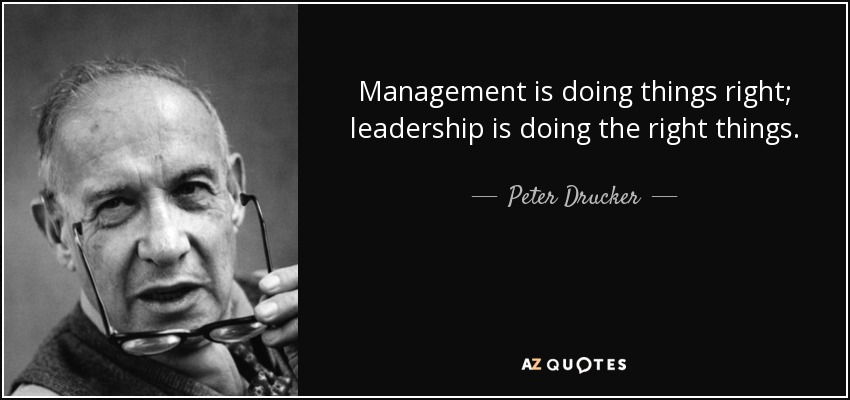
Drucker’s distinction is foundational:
“Management is doing things right; leadership is doing the right things.”
In the Psychotech framework:
- Management = Optimization
- Leadership = Alignment
Many leaders optimize wrong priorities.
Execution without alignment creates burnout.
Alignment without execution creates illusion.
The bridge between the two is contribution.
Ask daily:
- Does this activity move the needle?
- Does this action align with purpose?
- Is this effort creating value or just movement?
In high-performing organizations, leaders constantly recalibrate direction before accelerating speed.
3. The Central Idea: Effectiveness Before Efficiency
Drucker emphasizes five practices of effective executives:
1. Manage Your Time
Track it. Cut it. Consolidate it.
Time is not money.
Time is life force allocation.
Practical Psychotech Method:
- Conduct a 7-day time audit.
- Eliminate low-impact 20%.
- Consolidate high-focus blocks (90-minute deep work cycles).
If your calendar does not reflect your priorities, your priorities are fictional.
2. Focus on Contribution
Shift from activity to impact.
Most professionals ask:
“What is my task?”
Effective leaders ask:
“What result is expected from me?”
Contribution is external focus.
Ego dissolves. Impact expands.
Practical Drill:
- For every meeting, define one measurable outcome.
- For every project, define customer value.
- For every role, define contribution statement.
Contribution is oxygen to execution.
3. Build on Strengths
Drucker insists:
Do not fix weaknesses excessively. Amplify strengths.
In psychology, strengths generate flow.
In technology, leverage scales performance.
Weakness correction consumes energy.
Strength amplification multiplies it.
Application:
- Identify top 5 strengths (your own and team’s).
- Align roles with strengths.
- Delegate based on competence, not hierarchy.
Organizations collapse when energy is spent correcting misplacement instead of amplifying capability.
4. Concentrate on Few Priorities
“First things first—and second things not at all.”
In the digital age, distraction is epidemic.
Strategic focus requires:
- Ruthless elimination
- Sequencing discipline
- Boundary clarity
Practical Tool: The 3-Outcome Rule
Each quarter:
- Define 3 major outcomes.
- Align all initiatives under them.
- Eliminate non-aligned work.
If everything is priority, nothing is.
5. Make Effective Decisions
Drucker’s decision quality framework:
- Clear criteria
- Alternatives
- Dissent
- Action
- Feedback
In Psychotech systems, decision-making is not emotional reaction; it is structured thinking.
Practical Decision Protocol:
- Define the problem clearly.
- Identify boundary conditions.
- Generate at least 3 alternatives.
- Encourage constructive dissent.
- Decide.
- Implement with ownership.
- Review outcomes objectively.
Speed matters. But clarity matters more.
4. The Drucker Effectiveness Loop
The true architecture:
Purpose → Contribution → Execution → Learning → Results
Let’s expand this into a strategic cycle.
Step 1: Purpose — Why Does This Exist?
Purpose is directional intelligence.
Without purpose:
- Teams drift.
- Energy fragments.
- Decisions conflict.
Purpose aligns human psychology with organizational strategy.
Application:
Craft a Purpose Statement answering:
- Why do we exist?
- Whom do we serve?
- What transformation do we create?
Purpose reduces friction because people move with meaning.
Step 2: Contribution — What Results Matter?
Activity does not equal results.
Ask:
- What measurable change must happen?
- What does the customer truly value?
Drucker’s 5 Essential Questions:
- What is our mission?
- Who is the customer?
- What does the customer value?
- What are our results?
- What is our plan?
These questions precede strategy.
Without them, strategy is fantasy.
In Psychotech organizations:
Customer value = Emotional + Functional + Transformational impact.
Step 3: Execution — What Must Be Done First?
Execution is disciplined prioritization.
What gets measured improves.
Build dashboards:
- Weekly metrics
- Monthly outcomes
- Quarterly reviews
Execution without measurement is hope.
Execution with measurement is mastery.
Step 4: Learning — Feedback and Adjustment
The loop ends where most leaders fail: feedback.
Feedback is not criticism.
Feedback is calibration.
Learning culture creates adaptability.
Practical Implementation:
- After Action Reviews
- Monthly performance retrospectives
- Anonymous feedback channels
No feedback = slow decay.
Step 5: Results — Manage for Outcomes
Drucker’s final reminder:
Always manage for results, values, and responsibility.
Results alone create short-termism.
Values alone create stagnation.
Responsibility alone creates stress.
Integrated leadership balances all three.
5. The Knowledge Worker Shift
Drucker predicted the rise of knowledge workers. Today, we live in that reality.
Shift:
From control → contribution.
Key truths:
- Productivity is responsibility, not supervision.
- Workers own performance.
- Leaders create clarity and conditions.
Micromanagement destroys creative intelligence.
Psychotech Leadership Formula:
Clarity + Autonomy + Accountability = High Performance
Leaders must:
- Define outcomes clearly.
- Provide resources.
- Remove obstacles.
- Evaluate results objectively.
Control reduces innovation.
Trust amplifies ownership.
6. Communication: Hearing What Isn’t Said
Drucker’s quote:
“The most important thing in communication is hearing what isn’t said.”
In leadership psychology, this is emotional intelligence.
Observe:
- Silence patterns
- Energy shifts
- Body language
- Engagement levels
Technology amplifies communication—but psychology interprets it.
Effective leaders read both data and human signals.
7. Decision Quality as Strategic Weapon
Drucker on decision quality:
- Clear criteria
- Alternatives
- Dissent
- Action
- Feedback
In a Psychotech model, this prevents:
- Groupthink
- Emotional bias
- Authority distortion
- Execution paralysis
Encourage intelligent dissent.
Great decisions are born from constructive tension.
8. Practical Integration: A 90-Day Leadership Upgrade Plan
To convert this philosophy into transformation:
Month 1: Clarity & Alignment
- Define mission and purpose.
- Conduct time audit.
- Identify strengths map.
- Eliminate low-value tasks.
Month 2: Contribution & Execution
- Define 3 measurable outcomes.
- Build execution dashboard.
- Introduce structured decision process.
- Delegate based on strengths.
Month 3: Feedback & Learning
- Implement review systems.
- Conduct decision audits.
- Measure customer value perception.
- Adjust strategy based on results.
Repeat the loop quarterly.
9. Why This Is the Strongest Weapon in Leadership
Because it integrates:
- Psychology (purpose, strengths, contribution)
- Technology (measurement, systems, dashboards)
- Strategy (priorities, decisions, results)
- Execution (discipline, focus, feedback)
This is not motivational theory.
It is operational wisdom.
Drucker provides the skeleton.
Psychotech strategy adds the nervous system.
Execution gives it muscle.
Purpose gives it soul.
10. Final Insight: Leadership Is Lifting Vision
Drucker defines leadership as:
“Lifting a person’s vision to higher sights, raising performance to a higher standard, and building personality beyond its normal limitations.”
Leadership is expansion.
It is not control.
It is not authority.
It is not title.
It is capacity creation.
When leaders:
- Clarify purpose
- Focus on contribution
- Build on strengths
- Prioritize ruthlessly
- Decide effectively
- Measure results
- Learn continuously
Every challenge becomes opportunity.
Why?
Because the system is designed for growth.
Conclusion: The Lighthouse Principle
In turbulent environments, ships do not argue with storms.
They navigate using a lighthouse.
Drucker’s framework is that lighthouse.
Purpose directs.
Contribution focuses.
Execution drives.
Learning refines.
Results validate.
As a Psychotech Strategist, the integration of these principles creates:
- Conscious organizations
- High-performance cultures
- Responsible execution
- Sustainable impact
The future will not belong to the busiest.
It will belong to the most effective.
And effectiveness begins with one question:
What result truly matters?
Answer that clearly.
Align everything to it.
Execute relentlessly.
Learn continuously.
That is Drucker.
That is leadership.
That is strategic human evolution.

ANUPAM SHARMA
PSYCHOTECH™ STRATEGIST
COACH I MENTOR I TRAINER
COUNCELLOR I CONSULTANT