
Why “LEADERS STRATEGY IS TO MAKE, VISION THE MISSION…”
Leadership, at its core, is not about holding a position of authority but about carrying the power to transform possibilities into realities. Among the many facets of leadership, one of the most decisive is the ability to make vision the mission. This phrase, while deceptively simple, encapsulates the art and science of leadership strategy: the leader’s responsibility to transform a distant dream into a living, breathing operational agenda.
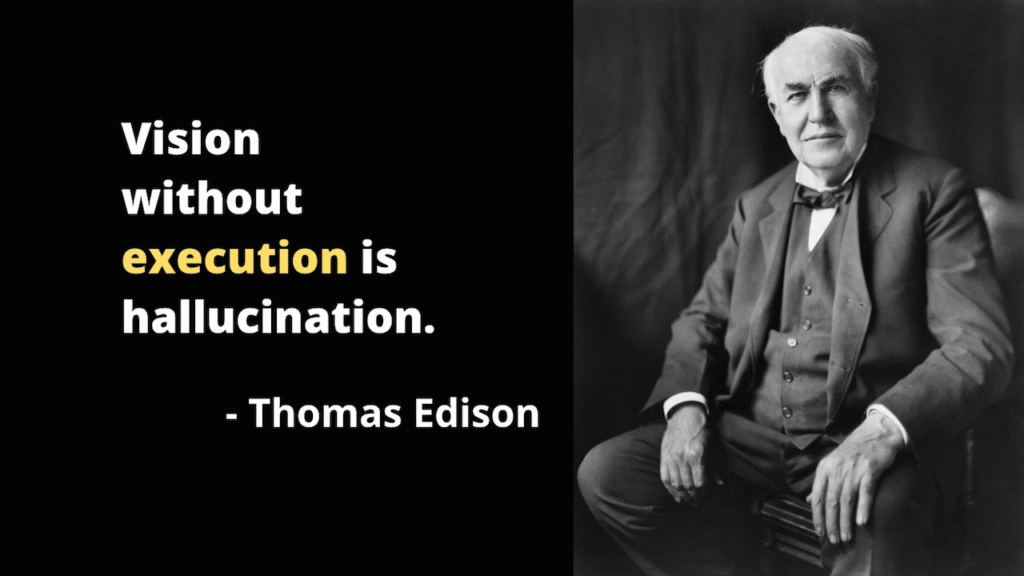
A vision without execution remains an idea; a mission without vision becomes mechanical. Leaders at their peak performance blend both—by creating a compelling vision and converting it into the daily mission of their teams, organizations, and societies.
1. Understanding the Statement: Why Vision Must Become the Mission
Vision: The North Star
A vision is an aspirational picture of the future—an ideal state the leader wants to achieve. It inspires, energizes, and sets direction. For instance, “to create a world where clean energy powers every home” is a vision that elevates thought beyond immediate tasks.
Mission: The Marching Orders
A mission, on the other hand, is the operational embodiment of vision. It outlines how the vision will be realized through actions, decisions, and milestones. It connects today with tomorrow.
When a leader makes vision the mission, they ensure that the dream of the future does not remain abstract but is systematically executed as a daily, collective effort. It becomes the heartbeat of strategy, culture, and performance.
2. The Significance in Attaining Leadership Peak Performance
Leadership peak performance lies in the ability to:
- Inspire people emotionally with vision.
- Align people strategically with mission.
- Drive people practically with execution frameworks.
A leader who separates vision and mission risks fragmentation. But a leader who unites vision into mission ensures continuity, clarity, and consistency—three anchors of high-performing leadership. This approach becomes the oxygen to execution and the fuel for organizational growth.
3. The Cause & Effect of the Concept
- Cause: Leaders create an inspiring vision and communicate it effectively.
- Effect: The team sees purpose in their tasks and connects their contribution to a larger outcome.
- Cause: Leaders embed the vision into mission-driven goals, frameworks, and processes.
- Effect: The organization sustains long-term growth with short-term discipline.
- Cause: Leaders align vision-mission with people’s aspirations.
- Effect: Trust, confidence, and loyalty flourish, transforming followers into co-owners of the purpose.
This cycle demonstrates why making vision the mission is not optional but existential for leaders.
4. How Leaders Practice the Strategy
Step 1: Craft a Compelling Vision
Leaders articulate a vision that is:
- Clear: Easily understood at every level.
- Compelling: Emotionally inspiring.
- Challenging: Stretching potential.
- Connected: Rooted in real needs and opportunities.
Step 2: Translate Vision into Mission Goals
Using frameworks like SMART goals (Specific, Measurable, Achievable, Relevant, Time-bound), leaders transform vision into actionable steps.
Example:
- Vision: “Build a digitally literate nation.”
- Mission: “Train 1 million rural youth in digital skills within five years.”
Step 3: Embed into Daily Execution
- Develop strategic roadmaps (yearly, quarterly, monthly).
- Align KPIs and OKRs with vision-derived goals.
- Ensure leaders at every level echo the vision-mission linkage.
Step 4: Make People the Custodians
Leaders empower individuals to “own” the mission. This requires:
- Communication clarity.
- Delegation with accountability.
- Recognition of contribution.
5. Frameworks, Tools & Techniques
a) The Lighthouse Framework
- Vision as Light: Guides direction.
- Mission as Path: Defines journey.
- Strategy as Vessel: Enables movement.
- People as Sailors: Drive execution.
Leaders act as lighthouses—ensuring the ship (organization) doesn’t lose direction amidst storms.
b) The Strategic Alignment Triangle
- Top Point – Vision: Defines ultimate aspiration.
- Left Point – Mission: Converts vision into actionable purpose.
- Right Point – Execution: Turns mission into measurable results.
c) The Golden Bridge Technique
Leaders build a bridge between:
- Current Reality (what is) and
- Future Possibility (what can be).
The bridge is the mission, held up by pillars of strategy, resources, and people commitment.
6. Why This Approach is Oxygen to Execution
Organizations without vision collapse into short-termism. Missions without vision result in fatigue. But when leaders make vision the mission:
- Every task has meaning.
- Every milestone echoes the larger picture.
- Every person feels indispensable.
This oxygen effect sustains motivation, resilience, and adaptability—qualities vital in uncertain, disruptive times.
7. How Leaders Build Strategic Mindsets
To master this philosophy, leaders must cultivate a strategic mindset through:
- Systems Thinking – Seeing interconnectedness between vision and execution.
- Scenario Planning – Anticipating future challenges and aligning mission accordingly.
- Adaptive Leadership – Modifying mission pathways without losing vision.
- Empathy & Influence – Connecting people’s personal goals with collective mission.
When leaders think strategically, every challenge becomes an opportunity to reinforce vision-mission synergy.
8. Big Four & Global Consulting Perspective
Global consulting firms like McKinsey, BCG, Deloitte, PwC have long emphasized that leadership effectiveness lies in embedding vision into mission. Their best practices include:
- McKinsey’s 7-S Model: Ensuring vision (shared values) aligns with mission (strategy, structure, systems).
- BCG’s Transformation Roadmaps: Converting vision into mission-critical initiatives.
- PwC’s Purpose-Driven Leadership: Making vision part of every stakeholder’s mission.
- Deloitte’s Human Capital Trends: Linking employee purpose with organizational mission for peak engagement.
This consulting perspective reinforces the universality of the concept.
9. Action Blueprint for Leaders
- Define – Write down the vision clearly in 1–2 sentences.
- Translate – Break the vision into 3–5 mission pillars.
- Align – Map mission pillars to measurable KPIs and OKRs.
- Communicate – Cascade the vision-mission alignment at all levels.
- Empower – Delegate ownership of mission goals to teams.
- Evaluate – Continuously track progress using dashboards and reviews.
- Celebrate – Recognize contributions that embody vision-mission execution.
- Refine – Adapt mission pathways while safeguarding the core vision.
10. Real-World Illustrations
- Steve Jobs (Apple): Vision—“Put a dent in the universe.” Mission—Design simple, elegant, user-friendly technology. Apple employees executed mission-driven innovation, anchored in Jobs’ vision.
- Mahatma Gandhi: Vision—“Independent India.” Mission—Non-violent civil disobedience. The mission became the people’s collective daily action, achieving the vision.
- Elon Musk (SpaceX): Vision—“Make humans multi-planetary.” Mission—Reduce space transportation costs and build reusable rockets. Vision became the mission for engineers and scientists.
These examples prove that leaders who align vision and mission produce transformational outcomes.
11. The Human Angle: Making Vision the People’s Mission
Peak leadership is not only about corporate goals but about earning, investing, and saving people’s purpose (from earlier prompts). Leaders achieve this by:
- Earning trust by linking vision to people’s aspirations.
- Investing energy in training and empowerment.
- Saving potential by channeling people into mission-driven growth.
When people see themselves in the mission, they give their best to realize the vision.
12. Conclusion: Leadership as a Living Strategy
To say “Leaders’ strategy is to make, vision the mission” is to declare leadership as a living practice, not a theoretical idea. Vision is the soul; mission is the body. Together, they form the living organism of leadership strategy.
Leaders at peak performance embody this truth:
- They dream beyond today with vision.
- They act every day with mission.
- They connect both seamlessly to inspire, align, and empower people.
When vision becomes the mission, leadership becomes unstoppable. It is this transformation that ensures leaders not only win challenges but also shape destiny.

Anupam Sharma
Psychotech Evangelist
Coach I Mentor I Trainer
Councellor I Consultant