
1. What Does “Leaders Experiment on Their Failures” Mean?
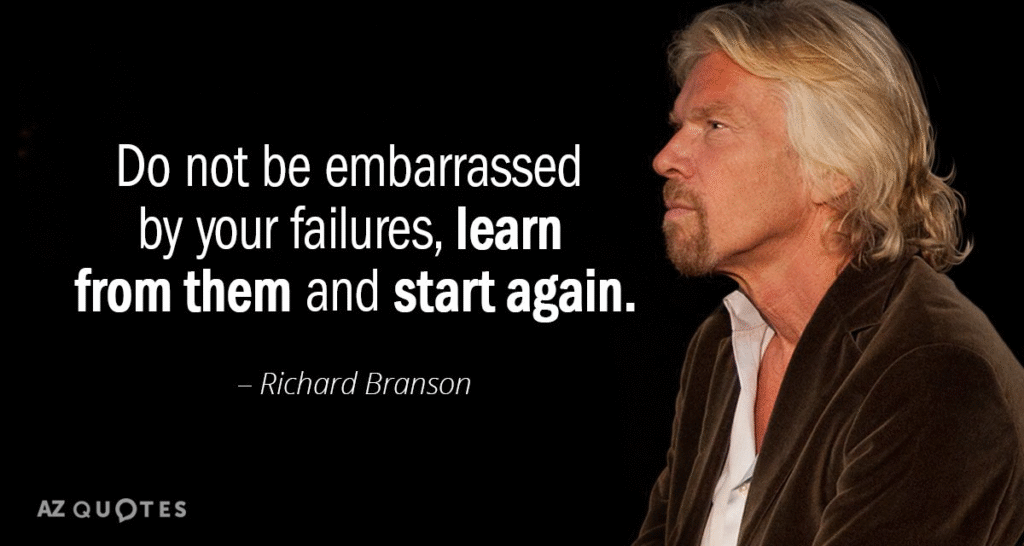
In leadership, failure is not merely the opposite of success—it’s a laboratory of insight.
When we say leaders experiment on their failures, it means:
- They treat setbacks as data points instead of dead ends.
- They run post-mortems, extract patterns, and test alternative strategies.
- They use failures as prototypes, iterating toward a more refined solution.
- They apply curiosity over criticism—asking “What can I try differently?” instead of “Why me?”.
For an ordinary individual, failure can be final; for a leader, it becomes raw material for innovation, resilience, and future breakthroughs.
2. Why Failures Are Opportunities for Consistency & Persistence
a. Psychological Reframing
Leaders reframe failures as learning loops, not losing moments.
Harvard Business Review research on deliberate practice shows that leaders who treat failures as feedback loops develop grit (persistence) and goal stamina.
b. Growth Mindset in Action
Stanford psychologist Carol Dweck’s research confirms that a growth mindset turns failure into a signal to adapt, not withdraw. Leaders who experiment on their failures keep trying new approaches until success aligns with vision.
c. Resilience Economics
From a McKinsey perspective, consistent experimentation with failed strategies allows incremental capability building—each adjustment improves resource allocation, team learning, and process efficiency.
3. Emotional Intelligence (EI) of Leaders in Failures & Critical Situations
Emotional Intelligence, as defined by Daniel Goleman, becomes the central nervous system for handling failure.
EI Components in Leadership Failures:
- Self-Awareness – Recognizing emotional reactions to setbacks.
- Self-Regulation – Avoiding impulsive blame or panic; keeping calm.
- Motivation – Using failure as fuel for renewed effort.
- Empathy – Understanding team emotions during tough times.
- Social Skills – Inspiring and aligning others despite setbacks.
Example:
Satya Nadella (Microsoft CEO) emphasized “growth mindset” post-failures in product launches. By publicly acknowledging mistakes, he built trust while steering teams toward smarter experimentation.
4. Strategic Thought Process, Evaluation & Action: How Leaders Bounce Back
Let’s integrate multiple frameworks, models, and principles into a failure-to-resourcefulness loop.
4.1 VRIO Framework (Barney, 1991)
Used to evaluate resources after failure:
- Value – What aspects of the failed project are still valuable?
- Rarity – Which unique strengths remain untapped?
- Imitability – Can lessons learned create hard-to-copy improvements?
- Organization – Is the team structured to use these insights effectively?
Application:
After a failed market entry, a leader may discover that the product’s technology is still valuable and rare, but marketing failed due to poor positioning. The VRIO analysis helps redirect efforts.
4.2 Scenario Planning (Royal Dutch Shell Model)
Used to simulate future possibilities post-failure:
- Identify critical uncertainties (e.g., market shifts, competitor moves).
- Develop multiple recovery scenarios.
- Stress-test decisions under each scenario.
Example:
After a failed product in one geography, leaders might plan Scenario A (pivot product features), Scenario B (target new market), and Scenario C (license technology).
4.3 SWOT Analysis
Post-failure reflection:
- Strengths – Skills, assets, and reputation intact after failure.
- Weaknesses – Processes, skills, or resource gaps exposed.
- Opportunities – Market gaps revealed by the failed attempt.
- Threats – Risks magnified by the setback.
Harvard Business School Note:
SWOT post-failure is diagnostic + prescriptive—helping leaders avoid repeated blind spots.
4.4 McKinsey 7S Framework
Ensures holistic recovery:
- Strategy – Revise action plans after learning from failure.
- Structure – Adjust org design for agility.
- Systems – Implement stronger monitoring and feedback systems.
- Shared Values – Reinforce mission alignment.
- Style – Shift leadership style to encourage experimentation.
- Staff – Upskill or reassign for better fit.
- Skills – Acquire missing capabilities revealed by failure.
4.5 RACI Matrix
Post-failure clarity on roles:
- Responsible – Who owns the fix?
- Accountable – Who has final decision authority?
- Consulted – Whose expertise is needed?
- Informed – Who needs updates?
MIT Sloan Research Insight:
Clear RACI reassignment post-failure improves speed of recovery by up to 30%.
4.6 Blue Ocean Strategy (Kim & Mauborgne)
Failures often occur in red oceans (crowded markets).
Leaders use failures to pivot toward uncontested spaces by:
- Eliminating low-value features.
- Reducing cost-heavy non-essentials.
- Raising unique value drivers.
- Creating new demand from non-customers.
Example:
Nintendo pivoted from competing with PlayStation/Xbox on raw power to creating the Wii—targeting family gaming (blue ocean) after console struggles.
5. Principles & Laws Leaders Apply to Failure Experiments
- OODA Loop (Observe–Orient–Decide–Act) – Rapid failure adaptation.
- Kaizen – Continuous small improvements post-failure.
- Pareto Principle (80/20) – Focus on the 20% of actions that can yield 80% of the recovery.
- First Principles Thinking (Elon Musk) – Strip the problem down to basic truths and rebuild.
- Second-Order Thinking – Evaluate long-term ripple effects of failure fixes.
6. Case Insights from Research & Think Tanks
Harvard Business Review – Fail Fast, Learn Faster
Study: Companies with a rapid experimentation culture recover from strategic failures 2–3x faster.
MIT Sloan Management Review – Failure as a Knowledge Asset
Finding: Organizations that document and share failure lessons create intellectual capital that boosts innovation rate by 46%.
Stanford GSB – The Failure-Tolerance Leadership Style
Key Insight: Leaders who reward experimentation (even when it fails) increase psychological safety, leading to 30% higher creative output.
Yale School of Management – Adaptive Leadership in Crises
Research: Leaders in volatile environments use scenario pivots and stakeholder empathy to regain momentum.
7. Strategic Recovery Blueprint: Failure → Experimentation → Breakthrough
Step 1 – Failure Post-Mortem
- VRIO & SWOT to evaluate assets and gaps.
Step 2 – Ideation & Scenario Design
- Apply Blue Ocean thinking + Scenario Planning.
Step 3 – Structure & Role Realignment
- Use McKinsey 7S + RACI Matrix.
Step 4 – Pilot Recovery Experiments
- OODA Loop & Kaizen cycles.
Step 5 – Knowledge Capture
- Institutionalize learnings (MIT approach).
Step 6 – Culture Reinforcement
- Embed failure tolerance in values (Stanford findings).
8. Leadership Mindset Shifts Post-Failure
- From “Avoiding Failure” → “Mining Failure”
- From “Blame” → “Ownership”
- From “Quick Fix” → “Sustainable Redesign”
- From “Fear” → “Curiosity”
Great leaders do not merely survive failure—they prototype success from it.
9. Real-World Examples
- Thomas Edison – 1,000+ failed experiments before the light bulb; treated each as “a step closer to success.”
- Steve Jobs – Used failures at Apple (Lisa, early Mac) to refine vision, later launching the iPod/iPhone ecosystem.
- Howard Schultz (Starbucks) – Closed hundreds of stores in 2008, retooled strategy, and returned to profitability.
- Indra Nooyi (PepsiCo) – Post-failure in healthy snack lines, used VRIO to leverage brand assets for a more impactful “Performance with Purpose” pivot.
10. Final Thought
“Failure is the tuition you pay for the degree in leadership.”
The leaders who experiment on their failures are not gamblers—they are calculated innovators. They apply frameworks, laws, and research not to erase mistakes but to extract the gold hidden inside them. This resilience and resourcefulness not only lead to strategic breakthroughs but also inspire teams, shareholders, and society to trust the leader’s journey.

Anupam Sharma
Psychotech Evangelist
Coach I Mentor I Trainer
Councelor I Consultant