
“Great Leaders Mastered to Challenge Strategic Threats”- Be a creative think tank…
Why This Is the Crux of Strategy Empowerment in a Competitive World**
Introduction: Strategy Is Not About Planning — It Is About Survival, Supremacy & Significance
History is brutally honest.
Great leaders did not win because they had more resources, more intelligence, or more people.
They won because they understood threats earlier, deeper, and clearer than others — and redesigned their strategy before the threat became fatal.
That is why the statement:
“Great leaders mastered to challenge strategic threats”
is not a motivational phrase.
It is the core law of strategic empowerment.
In business, leadership, geopolitics, careers, startups, or personal mastery — your success is directly proportional to how effectively your strategy neutralizes threats and converts them into leverage.
Strategy is not static.
Threats are not visible.
Competitors are not honest.
And time is never neutral.
This blog unpacks:
- Why strategy must always be superior to challengers
- How to detect strategy decay
- How to decode opponents’ strategy
- How to redesign your strategy using visualization, SWOT, 80/20, PDCA, PPF, Psychotech & Systems Thinking
- Why this ecosystem thinking creates unstoppable impact
1. Why Strategic Threat Management Is the Core of Strategy Empowerment
Strategy Exists Only Because Threats Exist
If there were:
- No competition
- No uncertainty
- No disruption
- No resistance
Then strategy would be unnecessary.
Threats give birth to strategy.
Great leaders understand:
You don’t lose when you fail — you lose when you fail to read the threat.
Strategic Threats Are Not Always External
Threats come from:
- External: competitors, technology shifts, regulation, market disruption
- Internal: complacency, ego, outdated beliefs, slow execution, cultural decay
- Psychological: fear, overconfidence, bias, emotional blindness
- Systemic: processes, incentives, misalignment, energy leakage
Strategy empowerment happens when leaders master all four dimensions simultaneously.
2. Why Your Strategy Must Always Be More Effective Than Your Challenger’s
Let us be brutally clear:
A good strategy is useless if your competitor’s strategy is better.
Relative Advantage Is the Only Advantage
Strategy is not judged in isolation.
It is judged relative to opponents.
- If your execution speed is slower → your strategy fails
- If your decision cycle is longer → your strategy fails
- If your clarity is weaker → your strategy fails
- If your adaptability is lower → your strategy fails
Great leaders therefore ask:
- Is my strategy faster?
- Is it clearer?
- Is it more resilient?
- Is it psychologically stronger?
- Is it future-ready?
3. Indicators That Demand Strategy Upgradation or Correction
Most leaders fail not because they don’t have strategy — but because they don’t know when to upgrade it.
Strategic Red Flags (Early Warning Signals)
1. Effort Increasing, Outcomes Plateauing
More work, less result = strategy fatigue.
2. Execution Becoming Reactive
Firefighting replaces proactive design.
3. Loss of Strategic Clarity
Teams execute tasks but cannot explain why.
4. Competitors Dictating Your Moves
When your actions are responses, not initiatives.
5. Time Lag Between Decision & Impact Increasing
Strategy is losing alignment with reality.
6. Energy Drain & Cultural Confusion
People feel busy but not powerful.
These indicators signal:
Strategy correction is not optional — it is urgent.
4. Understanding Opponents’ Strategy: The Invisible Battlefield
Great leaders do not fight competitors.
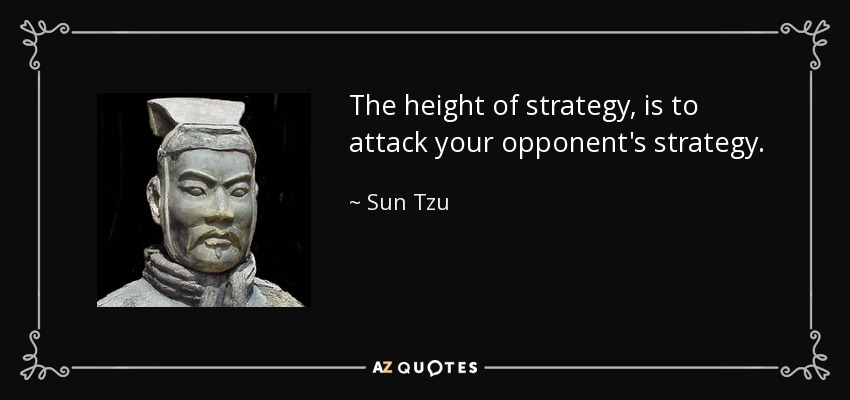
They fight competitors’ strategy models.
Strategy Is Mental Before It Is Operational
To redesign your strategy, you must decode:
- How opponents think
- What they prioritize
- What they fear
- Where they overinvest
- Where they are blind
Strategic Intelligence Questions
Ask relentlessly:
- What problem do they believe they are solving?
- What assumptions are they betting on?
- What are they optimizing for — speed, scale, cost, brand, control?
- What is their weakest constraint?
- What happens if the environment changes suddenly?
This is psychotech warfare, not surface analysis.
5. Applying Core Frameworks to Decode & Redesign Strategy
A. SWOT — Beyond the Textbook
Used by great leaders not as analysis, but as strategic weaponry.
- Strengths → Where can I dominate uncontested?
- Weaknesses → Where must I defend or exit?
- Opportunities → Where timing gives unfair advantage?
- Threats → Where disruption can collapse my model?
Elite move:
Convert Threats into Opportunities by changing perspective, not resources.
B. 80/20 Principle — Strategy Distillation
80% of outcomes come from 20% of strategic decisions.
Great leaders:
- Identify the vital few threats
- Ignore the trivial many distractions
- Invest disproportionate energy in leverage points
Strategic clarity emerges when noise is eliminated.
C. PDCA — Strategy as a Living System
- Plan: Strategic hypothesis
- Do: Controlled execution
- Check: Reality feedback
- Act: Intelligent correction
Strategy empowerment comes from learning speed, not planning perfection.
D. PPF (Production Possibility Frontier) — Strategic Trade-Off Mastery
Every strategy involves sacrifice.
- Where are you over-allocating?
- Where are you under-investing?
- What must you stop doing to win?
Great leaders win by choosing what NOT to pursue.
6. Visualization: The Core Engine of Absolute Strategic Solutions
As discussed earlier:
Great ideas rest in great problems; great solutions appear through great visualization.
Why Visualization Is Non-Negotiable
Visualization allows leaders to:
- Simulate future threats
- Stress-test strategy
- See second-order consequences
- Integrate emotion + logic + systems
Visualization turns:
- Complexity → clarity
- Chaos → structure
- Fear → foresight
It is the bridge between strategy and certainty.
7. Strategy Across Time: Past, Present & Future Integration
Past — Strategic Memory
- What worked?
- What failed?
- What assumptions died?
Present — Strategic Reality
- What is happening now?
- Where is friction?
- Where is momentum?
Future — Strategic Imagination
- What can disrupt us?
- What must we become?
- What capabilities are non-negotiable?
Great leaders operate in three timelines simultaneously.
8. The Complete Strategy Ecosystem
A powerful strategy ecosystem integrates:
- Mindset – Psychological resilience
- Models – Framework clarity
- Metrics – Reality feedback
- Momentum – Execution rhythm
- Meaning – Purpose alignment
When any one is missing, strategy collapses.
9. Why This Approach Creates Massive Impact & Purpose Fulfillment
Because:
- You are not reacting — you are shaping
- You are not competing — you are redefining
- You are not surviving — you are leading evolution
Great leaders do not eliminate threats.
They outgrow them.
Conclusion: Strategy Is the Art of Staying Ahead of Reality
The ultimate truth is this:
Strategy empowerment is not about winning today — it is about staying relevant tomorrow.
Great leaders master strategic threats because they:
- Think deeper
- Visualize farther
- Learn faster
- Act smarter
- Correct earlier
When your strategy becomes more adaptive than your challengers’,
competition becomes irrelevant and purpose becomes inevitable.

Anupam Sharma
Psychotech Strategist
Coach I Mentor I Trainer
Councelor I Consultant