

“ACTIVE LISTENING Is the OXYGEN for STRATEGY.”
Yes , STRATEGIC LEADER’S lead actively by this practice !
In the world of leadership, communication is often misunderstood as speaking well. But the highest-performing leaders across history—from Chanakya to Steve Jobs, from Satya Nadella to Nelson Mandela—understood a deeper truth:
“Leadership is not in speaking, it is in listening.” Because listening fuels awareness, awareness fuels clarity, and clarity fuels STRATEGY.
Just like oxygen sustains biological life, active listening sustains strategic intelligence. Without it, decisions become assumptions, communication becomes noise, execution becomes misaligned, and leadership becomes positional—not impactful.
Why Active Listening Is the Crux of Strategic Communication
A strategy is not created from opinions. A strategy is created from:
- Inputs
- Insights
- Interpretations
- Interconnections
- Intentional decision-making
Active listening is the gateway to all five.
When leaders listen deeply—not to react, but to understand—they unlock a 360° perception of:
- What is happening
- Why it is happening
- What is not being said
- What system patterns and opportunities exist
- What decisions will create the highest leverage
This is where frameworks like:
- SWOT
- Blue Ocean Strategy
- Root Cause Analysis (RCA)
- 80/20 Pareto Principle
- Systems Thinking
- Emotional Intelligence Model
- PDCA (Plan–Do–Check–Act)
become effective—not as tools, but as strategic amplifiers of deep listening.
Because a framework is only as powerful as the depth of listening before applying it.
Active Listening vs Passive Hearing: The Psychology Behind It
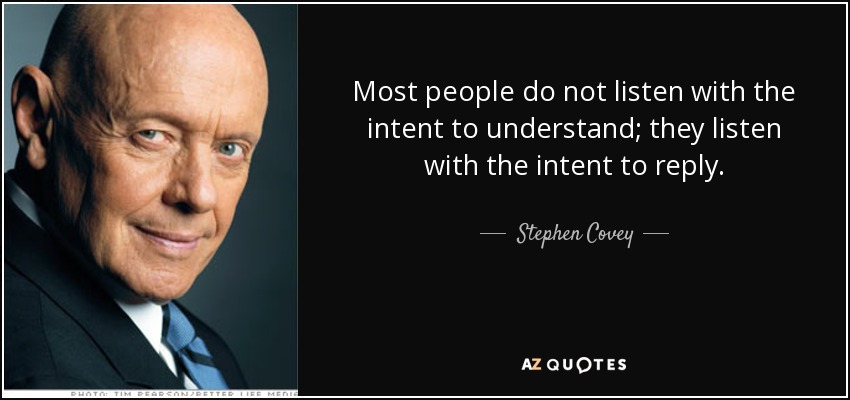
Most people do not listen to understand.
They listen to reply.
Or worse—listen to defend.
This reactive pattern stems from human psychology driven by:
- Ego Protection
- Cognitive Bias
- Fear of Losing Control
- Desire to Be Right
- Survival Instincts
This is where the statement becomes clear:
“Listening without understanding is simply noise.”
A reactive listener hears facts but misses meaning.
An impatient listener hears words but misses emotions and intentions.
A strategic listener hears:
- The message
- The context
- The gap
- The motive
- The opportunity
Active listening demands silence, presence, and patience.
It is a disciplined leadership behavior—not a personality trait.
Leadership Traits Revealed Through Active Listening @ 360°
When a leader listens actively, they demonstrate multiple leadership traits simultaneously:
| Leadership Trait | How Active Listening Builds It |
|---|---|
| Humility | Shows willingness to learn instead of assume |
| Empathy | Understands emotions, not just information |
| Emotional Intelligence | Controls reactions, increases influence |
| Cognitive Awareness | Recognizes patterns, blind spots, insights |
| Strategic Foresight | Identifies risk and opportunities others miss |
| Clarity of Thought | Filters complexity into meaningful priorities |
| Trust-Building | People feel respected, valued, and included |
This is why great leaders do not dominate the conversation—they hold the space for clarity to surface.
The Cost of NOT Listening: Corporate Reality
Organizations do not fail because people do not speak.
They fail because nobody is listening.
- Nokia failed not because they lacked innovation,
but because leadership wasn’t listening to internal warnings. - Kodak didn’t lose the digital race because the technology was missing;
they ignored the engineer who invented the first digital camera inside Kodak. - Many mergers collapse because executives listened to assumptions, not culture, people dynamics, or operational reality.
Strategic failure is often listening failure.
Active Listening as a Strategic Weapon
Active listening sharpens strategy in five powerful dimensions:
1. Intelligence Gathering
Like a military commander studying the battlefield, a corporate leader uses listening to gather:
- Market signals
- Customer expectations
- Risks and disruptions
- Internal team dynamics
- Competitor movement
This aligns with:
SWOT + PESTLE + Market Intelligence = Strategic Awareness
2. Pattern Recognition & Insight Extraction
Using frameworks like:
- Root Cause Analysis (5 Why’s)
- Systems Thinking
- Cause-Effect (Ishikawa Diagram)
a leader transforms scattered information into strategic meaning.
Listening → Understanding → Insight → Direction
3. Decision-Making Precision
A leader using the 80/20 Rule and PDCA Cycle becomes intentional:
- 20% insights → 80% strategic execution
- Listen → Think → Validate → Decide → Execute
No rushing.
No assumption-based reactions.
Only proactive, evidence-backed strategic action.
4. People Empowerment
People feel respected when they are heard—not interrupted or dismissed.
Active listening:
✓ Boosts confidence
✓ Builds belonging
✓ Creates psychological safety
✓ Encourages contribution
✓ Enhances accountability
A leader who listens well communicates:
“Your perspective matters.”
That turns employees into ambassadors and followers into collaborators.
5. Innovation and Continuous Improvement
Breakthrough ideas rarely come from top leadership.
They emerge from:
- Frontline teams
- Customers
- Users
- Analysts
- Engineers
Leaders who listen unlock innovation because they allow diversity of thinking.
Satya Nadella transformed Microsoft from a competitive ego-based culture into a listening-driven growth mindset culture.
Result?
- Market value increased exponentially.
- Internal collaboration became strength.
- Product strategy aligned with customer reality.
Strategic Listening Models: The Transformation Approach
A. 5-Level Listening Hierarchy
| Level | Type of Listening | Leadership Output |
|---|---|---|
| 1 | Hearing | Noise Recognition |
| 2 | Selective Listening | Bias Confirmation |
| 3 | Active Listening | Understanding Information |
| 4 | Empathic Listening | Understanding Emotion & Intention |
| 5 | Strategic Listening | Insight > Strategy > Execution |
Only Level 5 creates strategic advantage.
B. The 4R Active Listening Framework
| Step | Description |
|---|---|
| Receive | Hear without interrupting |
| Reflect | Repeat or paraphrase for confirmation |
| Recognize | Acknowledge emotion and meaning |
| Respond | Speak only after clarity and validation |
Corporate Examples of Strategic Listening
🟦 Toyota Production System (TPS)
Toyota became legendary because leaders listened to workers closest to the problem.
Any employee could stop the production line with a cord—called Andon.
This built:
- Zero defect culture
- Respect for intelligence
- Continuous improvement (Kaizen)
🟦 Google’s 20% Rule
Google discovered breakthrough ideas (Gmail, AdSense, Google News) not by top-down orders—but by listening to employee creativity.
🟦 Starbucks: Customer Listening Culture
Howard Schultz redesigned store experience not from spreadsheets—but from listening to customers’ emotional connection with coffee.
Active Listening = Influence, Alignment & High Performance
When a leader listens:
- Teams align faster
- Conflicts reduce
- Execution strengthens
- Trust compounds
- Decisions accelerate
- Retention increases
Because listening creates resonance, and resonance creates followership.
Conclusion: Listening Is Leadership. Listening Is Strategy.
A leader who doesn’t listen leads from assumption.
A leader who listens leads from wisdom.
Active Listening is more than a skill — it is a leadership discipline, a cultural force, and a strategic advantage.
The leader who listens becomes:
- A strategist
- A problem solver
- A mentor
- A catalyst
- A visionary
Because through listening, they understand what others cannot see—and what the future demands.

Anupam Sharma
Coach I Mentor I Trainer
Councelor I Consultant