

1. What is Active Listening?
Active listening is the conscious, intentional process of fully engaging with, interpreting, and responding to the speaker. It involves:
- Giving full attention without interruption
- Observing non-verbal cues
- Clarifying through questions
- Paraphrasing to confirm understanding
- Responding empathetically
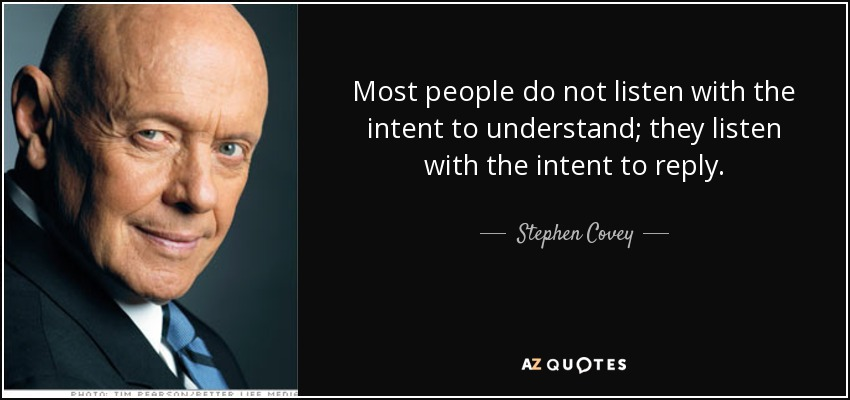
“The biggest communication problem is we do not listen to understand. We listen to reply.” – Stephen Covey
💡 2. Why Active Listening Defines Leadership
Leadership is about guiding, empowering, and transforming others. You can’t do that effectively if you’re disconnected from the people you lead. Active listening empowers leaders to:
- Build trust and psychological safety
- Decode real challenges behind surface problems
- Foster empathy and emotional connection
- Make better, informed decisions
- Empower team members by making them feel heard
A great leader listens not to control, but to co-create solutions.
🔄 3. Active Listening vs Passive Listening
| Trait | Passive Listening | Active Listening |
|---|---|---|
| Focus | Distracted, divided attention | Full presence |
| Intent | To respond/react | To understand |
| Feedback | Rare, generic | Reflective, meaningful |
| Non-verbal | Disengaged posture | Eye contact, nodding |
| Outcome | Miscommunication | Clarity & Connection |
🌐 4. How Active Listening Complements Other Leadership Traits
| Leadership Trait | How Active Listening Enhances It |
|---|---|
| Empathy | Understands unspoken emotions and needs |
| Emotional Intelligence | Regulates reactions and connects authentically |
| Vision | Aligns team aspirations with goals |
| Decision Making | Uses ground-level input to inform strategy |
| People Empowerment | Makes people feel valued and respected |
| Conflict Resolution | Identifies root causes before reacting |
🧠 5. Models & Frameworks to Understand Active Listening Better
🔍 A. RCA (Root Cause Analysis)
Active listening is key to identifying why a problem exists—not just what the problem is.
E.g., in a team underperforming, active listening helps uncover hidden issues: lack of clarity, burnout, poor alignment—not just incompetence.
⚖️ B. 80/20 Rule (Pareto Principle)
Often, 20% of the conversations yield 80% of the insights.
A leader who listens intentionally to the key 20% (people with ground insights, repeat customer pain points) can make 80% of critical decisions with more confidence.
🧩 C. Rapport Building Techniques
- Mirroring tone/posture subtly
- Validating the speaker’s experience
- Using affirming body language
All these tools require active listening at their core.
📥 D. GTD (Getting Things Done) Model – David Allen
In GTD, the first step is “Capture”—you must absorb information completely before clarifying or organizing it.
Active listening is essential to capture with clarity, especially in coaching, delegation, and strategic feedback sessions.
🤝 E. People Empowerment Strategies
When team members feel heard:
- Motivation increases
- Self-responsibility improves
- Innovation rises
Listening becomes a leadership multiplier.
🧩 F. Problem-Solving
The quality of your solution depends on the quality of your diagnosis—which begins with deep listening.
Leaders often fix symptoms, not root causes, because they didn’t listen long enough.
🧠 G. Emotional Intelligence (EQ)
Daniel Goleman’s EQ model includes:
- Self-awareness
- Self-regulation
- Motivation
- Empathy
- Social skills
All of these improve drastically through intentional listening.
🧘 6. Link Between Active Listening & the 5 Human Organs (Sensory Organs)
| Organ | Role in Active Listening |
|---|---|
| Ears | Primary receiver of auditory input |
| Eyes | Observe facial cues, body language |
| Skin | Sense tension, vibrations, physical response |
| Tongue | Respond with appropriate tone and empathy |
| Nose | Read the emotional environment (stress pheromones, ambiance cues) |
Active listening is multi-sensory. True leadership listens with the whole self, not just ears.
🧭 7. How to Identify, Learn & Master Active Listening
✅ Identification: Are you really listening?
- Do you interrupt often?
- Do you finish others’ sentences?
- Do you think of your response before they finish?
- Do people open up to you easily?
If you answered “yes” to the first three and “no” to the last—it’s time to upgrade.
🎯 Learning & Mastering:
A. The “SLANT” Technique (Used in classrooms, applicable to leaders)
- Sit up
- Listen
- Ask and answer
- Nod
- Track the speaker with eyes
B. 4R’s Model of Listening Mastery
- Receive without judgment
- Reflect emotions and meaning
- Rephrase key points
- Respond thoughtfully
C. Habit-Stacking with Daily Routines (Atomic Habits Inspired)
E.g., every morning stand-up → Practice 5 mins of silent active listening with your team
E.g., after every feedback meeting → Reflect and journal what was truly said vs what you assumed
🌀 8. Cultural, Strategic & Spiritual Dimensions
- In Japanese culture, the concept of “Ma” emphasizes the silent space between words—it’s sacred. Active listening honors this space.
- In Bhagavad Gita, Krishna didn’t start advising Arjuna until he expressed his pain fully. That’s leadership through listening.
- Top consulting firms (McKinsey, BCG) use tools like empathy mapping and emotional journey tracking—which are grounded in active listening techniques during client interactions.
🧱 9. Tools & Exercises to Build Active Listening Muscles
- 🎙️ The Echo Game – Paraphrase everything said back to the speaker.
- 🧘♂️ Mindfulness Training – Increase presence during conversations.
- 🧠 Cognitive Journaling – After conversations, write down what you heard vs what was meant.
- 🎤 Role-play Sessions – Practice high-stakes conversations with listening as your only superpower.
🔗 10. Final Thought: Leadership is 80% Listening, 20% Impact
You don’t have to be the loudest in the room to lead.
You must be the one who hears what others won’t say.
That’s how you empower silently, decide wisely, and transform profoundly.
“To listen well is as powerful a means of communication and influence as to talk well.” – John Marshall
🚀 Call to Action:
Start with one act today:
Listen to someone completely for 5 minutes without interrupting, judging, or fixing.
You may just become the leader they never had—but always needed.

Anupam Sharma
Psychotech Evangelist
CoachI Mentor I Trainer
Counselor I Consultant
Comments are closed.