
Why True Leaders Innovate While Managers Merely Administer
“Innovation distinguishes between a leader and a follower.” – Steve Jobs
1. Introduction: The New Paradigm of Leadership
In an age defined by volatility, uncertainty, complexity, and ambiguity (VUCA), leadership is no longer just about efficiency, control, or decision-making—it is about 360-degree innovation. When we say “Leadership is Innovation @ 360°,” we mean leadership must innovate across every vector—strategy, systems, culture, process, products, people, and purpose.
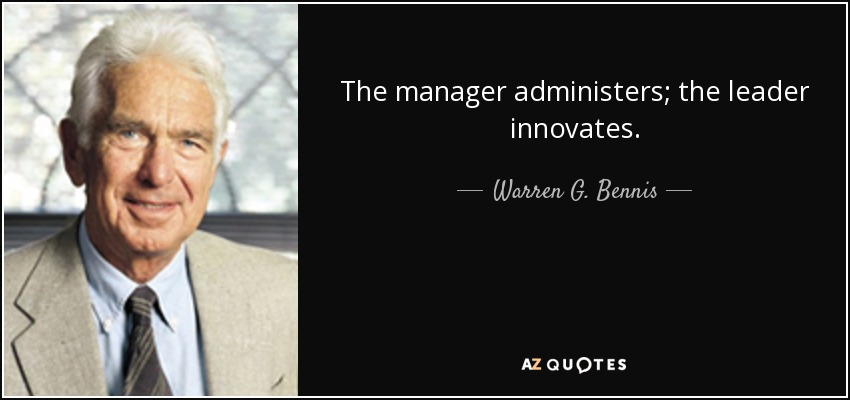
A manager may administer the present, but a leader must architect the future. While administration sustains, innovation transforms.
According to a McKinsey Global Survey, 84% of executives agree that innovation is extremely important to their growth strategy—but only 6% are satisfied with their innovation performance. This gap underscores the dire need for Innovation-Driven Leadership.
2. Why Managers Administer, But Leaders Innovate
| Dimension | Manager | Leader |
|---|---|---|
| Role | Maintains status quo | Drives change |
| Time orientation | Short-term, operational | Long-term, visionary |
| Process | Follows rules | Reinvents models |
| Decision-making | Structured, by protocol | Strategic, adaptive |
| Innovation | Risk-averse | Risk-intelligent and proactive |
Harvard Business Review notes: “Innovation requires challenging the existing order, which is uncomfortable for managers conditioned to seek stability.”
Leaders, on the other hand, create psychological safety and purpose-driven cultures where creativity, experimentation, and disruption are not only allowed—but encouraged.
3. Strategic Goal Setting: The Seed of Innovation
Innovation must start with strategic goal clarity. The Big Four (McKinsey, BCG, Bain, Deloitte) use frameworks like:
a) SMARTER Goals Framework
- Specific, Measurable, Achievable, Relevant, Time-bound, Evaluated, Reviewed
- Aligns innovation efforts with business outcomes.
b) OGSM Model
- Objectives, Goals, Strategies, Measures
Used widely by Procter & Gamble and advised by Bain & Co, OGSM aligns long-term aspirations with actionable innovation milestones.
c) OKRs (Objectives and Key Results)
- Used by Google, Intel, and adopted by Deloitte consulting clients
- Ensures teams innovate toward key breakthrough results with focus and flexibility.
4. Critical Thinking: Innovation’s Cognitive Engine
Innovation is not just about ideas—it’s about the quality of thinking behind them. Top consulting firms embed critical thinking through:
a) MECE Principle (Mutually Exclusive, Collectively Exhaustive) – McKinsey
- Breaks down complex problems to explore innovation paths clearly.
b) Issue Tree Analysis
- Dissects root causes of stagnation and opportunities for new value creation.
c) SCAMPER Technique
- Substitute, Combine, Adapt, Modify, Put to another use, Eliminate, Reverse – used to creatively think about product/process improvements.
IBM’s Design Thinking integrates creative ideation with critical evaluation, now adopted by over 400 Fortune 500 firms.
5. PPF Analysis: Past-Present-Future Mapping for Innovation
A proprietary tool in executive coaching and consulting circles, PPF Analysis decodes innovation opportunities by dissecting:
| Timeframe | Focus | Innovation Opportunity |
|---|---|---|
| Past | Legacy systems, culture, failures | What must be reformed or let go? |
| Present | Core competencies, strengths, roadblocks | What can be optimized or repurposed? |
| Future | Trends, disruptions, unmet needs | What must be created or pioneered? |
BCG’s Transformation Framework begins with this backward-forward scan before deploying innovation agendas.
6. PLC Evaluation: Innovating Across Product Lifecycle
Product Life Cycle (PLC) evaluation helps leaders spot inflection points for innovation.
| Stage | Innovation Focus |
|---|---|
| Introduction | Blue ocean strategy, MVP design, early adopters |
| Growth | Scalability, new market penetration, feedback loops |
| Maturity | Differentiation, cost innovation, customer experience revamp |
| Decline | Sunset strategy, pivot models, disruptive reinvention |
Deloitte uses PLC mapping in Digital Transformation Journeys to introduce AI, automation, or platform shifts at maturity or decline phases.
7. Discovery Analysis: The Innovation DNA
Every consulting engagement begins with Discovery Analysis—a deep diagnostic of what is, what isn’t, and what could be. Core elements include:
a) SWOT + TOWS Matrix
Converting weaknesses into opportunities and threats into innovation possibilities.
b) Design Thinking Discovery Phase
- Empathize → Define → Ideate → Prototype → Test
- Used by Accenture, IDEO, and Deloitte Digital
c) Voice of Customer (VoC) + Jobs to Be Done (JTBD)
Understand unmet needs and latent desires as innovation anchors.
Research by Harvard’s Clayton Christensen shows: “95% of innovation failures occur due to poor understanding of the real job customers want done.”
8. Strategic Frameworks Used by Big Four & Top Consulting Groups
a) McKinsey’s Three Horizons of Growth
- Horizon 1: Core innovation
- Horizon 2: Adjacent market expansion
- Horizon 3: Disruptive/new innovation
Encourages leaders to balance today’s needs with tomorrow’s breakthroughs.
b) BCG’s Innovation-to-Impact Chain
- Discover → Develop → Diffuse → Deliver
Used to track innovation from ideation to actual business impact.
c) Deloitte’s Business Chemistry + Greenhouse Innovation Labs
- Combines neuroscience with leadership behavior analysis to cultivate innovative teams.
d) Bain’s Elements of Value Pyramid
- Focuses on delivering functional, emotional, life-changing, and social impact value through innovation.
9. Tools & Models Empowering 360° Innovation Leadership
| Tool/Model | Purpose in Innovation |
|---|---|
| Blue Ocean Strategy | Create uncontested market space |
| Eisenhower Matrix | Prioritize innovation efforts based on urgency/importance |
| Theory of Constraints (TOC) | Identify bottlenecks in the innovation pipeline |
| Business Model Canvas | Reframe how value is delivered, captured, and created |
| Balanced Scorecard (BSC) | Align innovation KPIs across financial, customer, process, and learning axes |
| Ansoff Matrix | Explore market vs product-based innovation directions |
10. Closing the Loop: Becoming the Innovation Lighthouse
A leader practicing Innovation @ 360° doesn’t just innovate in product or profit. They inspire innovation in:
- Culture – psychological safety, growth mindset
- Process – agility, lean experimentation
- People – skill upgradation, intrapreneurship
- Purpose – aligning values with vision
- Platform – adopting tech-enabled future-readiness
As Jeff Bezos said, “If you don’t understand the details of your business, you are going to fail. But if you’re not constantly reinventing it, you’re already dead.”
Conclusion: From Leader to Innovator-in-Chief
Leadership today is not a static title—it’s a dynamic innovation role. A leader who doesn’t innovate across 360° will soon become obsolete in a world that reinvents itself every quarter.
Great leaders:
- Set strategic innovation goals
- Engage in critical thinking
- Use PPF and PLC lenses to forecast change
- Deploy global consulting frameworks
- Embrace discovery, not just delivery
🔧 Leadership Innovation Toolkit for C-Suite Leaders
| Tool/Technique | Use Case |
|---|---|
| MECE + Issue Tree | Structured innovation problem-solving |
| SCAMPER | Creative ideation |
| OKRs | Execution focus |
| Three Horizons Model | Balanced innovation portfolio |
| JTBD | Customer-centered innovation |
| Business Model Canvas | Business model reinvention |

Anupam Sharma
Psychotech Evangelist
Coach I Mentor Trainer
Counselor I Consultant